Saudi-Houthi escalation intensifies; Ukraine reports no warning of Russian strike
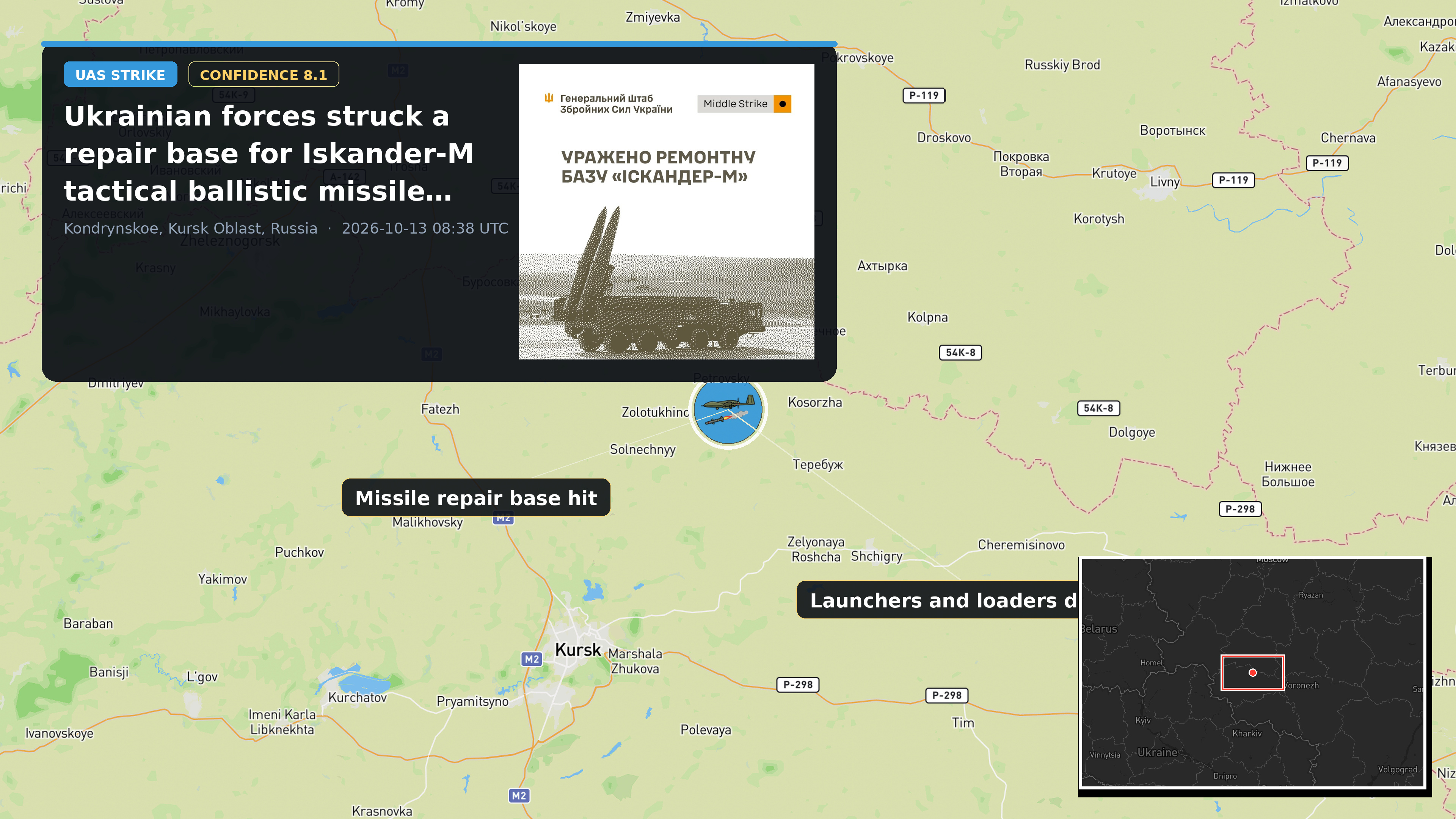
Ukrainian forces struck a repair base for Iskander-M tactical ballistic missile systems and transloader vehicles in Kondrynskoe, Kursk Oblas
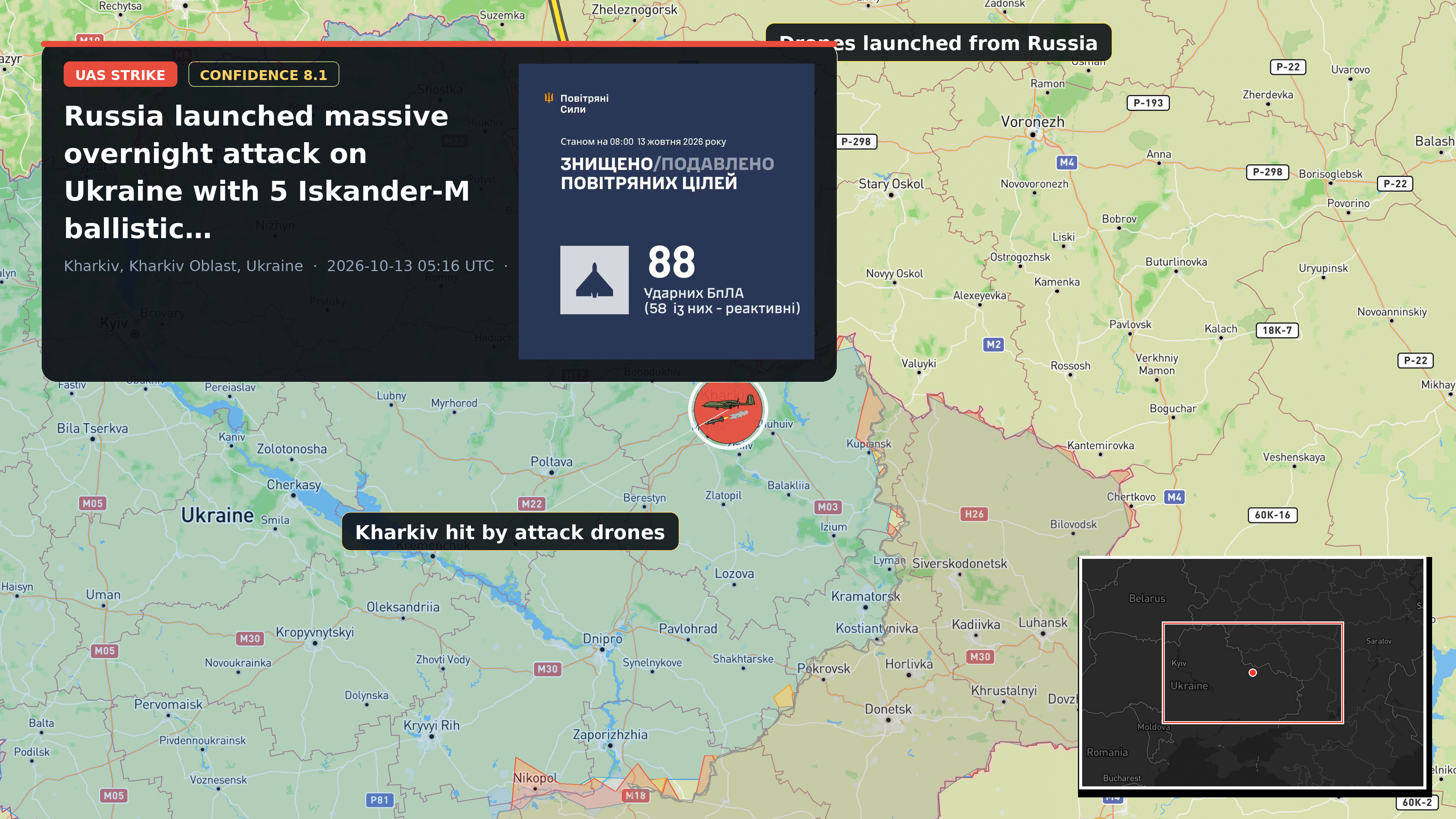
Russia launched massive overnight attack on Ukraine with 5 Iskander-M ballistic missiles, 9 Banderol loitering munitions, and 108 Shahed dro
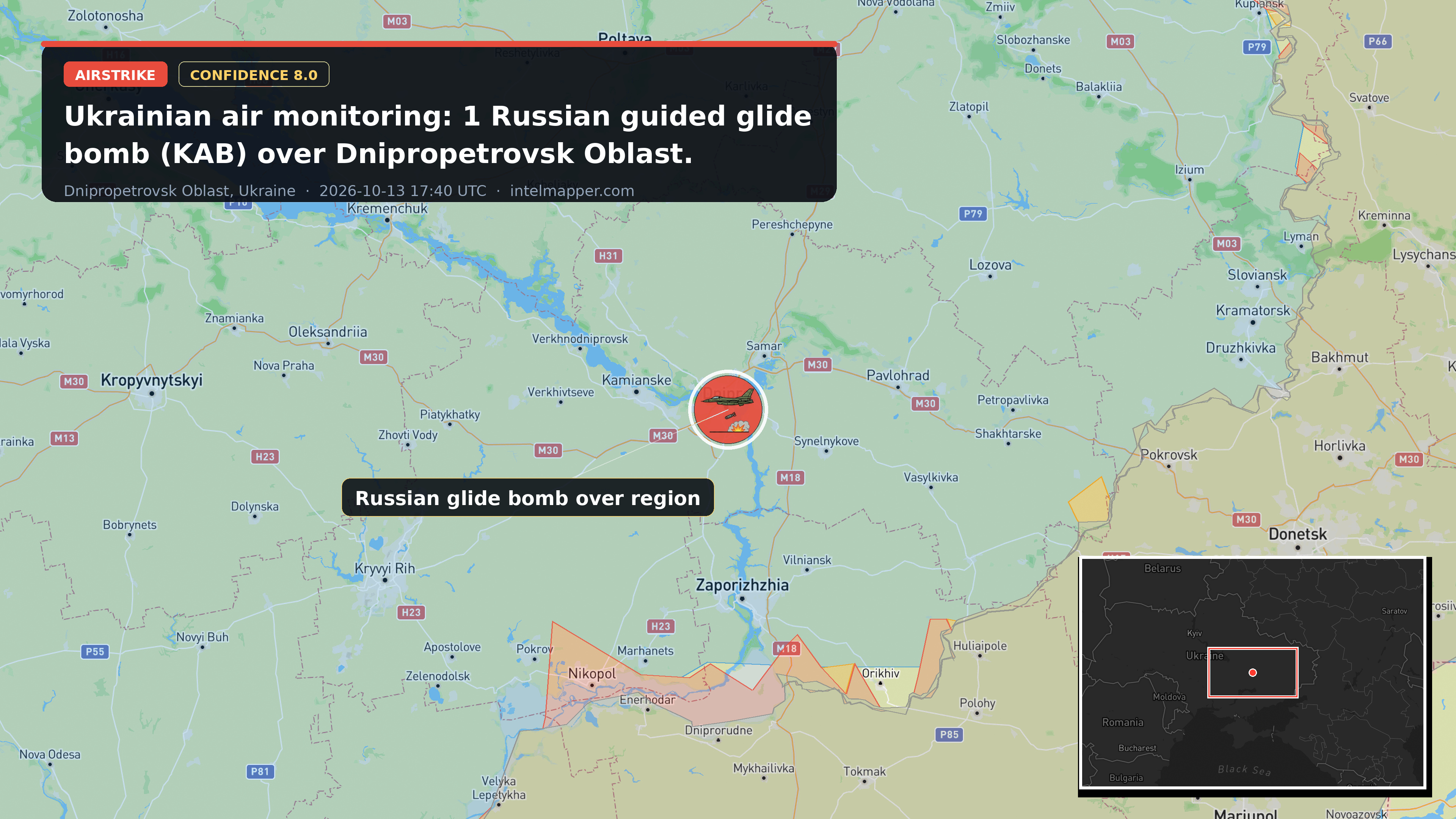
Ukrainian air monitoring: 1 Russian guided glide bomb (KAB) over Dnipropetrovsk Oblast.
Ukrainian President Zelenskyy stated on 13 October that Ukraine received no advance warning from Western partners of a massive Russian ballistic missile attack on Kyiv the previous night. A U.S. official attributed the lack of warning to poor weather conditions preventing communication, an explanation Zelenskyy disputed as inadequate. The incident highlights persistent friction between Ukrainian command and Western intelligence sharing protocols, particularly regarding time-sensitive strategic threats. Zelenskyy confirmed Ukraine has voluntarily withheld escalatory strikes, positioning Kyiv as the strategically restrained party despite Russian offensive operations.
Russian unmanned systems maintained sustained pressure across Ukrainian territory on 13 October. Ukrainian air monitoring detected approximately 20+ Shahed-type jet-powered drones (Geran-3 variants) transiting multiple oblasts including Zhytomyr, Rivne, Khmelnytskyi, Poltava, Cherkasy, Dnipropetrovsk, and Chernihiv, with individual and multi-drone sorties targeting civilian population centers including Kyiv, Kharkiv, Kremenchuk, and Myrhorod. A single Russian guided glide bomb was observed over Dnipropetrovsk Oblast. Russian tactical fighter aircraft conducted active operations in northeastern Ukraine, indicating multi-vector pressure across the country. The scale and geographic distribution of drone transits reflect continued Russian capability to conduct distributed strikes despite Ukrainian air defense efforts.
The intelligence dispute and operational tempo reveal the asymmetric nature of the conflict. Ukraine possesses effective tactical-level air monitoring and early warning systems but lacks strategic-level advance intelligence from Western partners equipped with satellite and signals intelligence. Russian forces maintain the initiative in terms of strike frequency and distribution, while Ukrainian defense concentrates on tactical interception and damage mitigation rather than preemption. The continued voluntary Ukrainian restraint on escalatory strikes, despite unwarned attacks on capital infrastructure, suggests Kyiv remains constrained by political and military calculations favoring Western support over independent retaliation options.
Key developments
- Saudi-led coalition airstrikes targeted Houthi petroleum and missile infrastructure in Sana'a; Houthis responded with drone strikes and named three Saudi targets for retaliation.
- Ukraine received no advance Western intelligence warning of Russian ballistic missile attack on Kyiv; U.S. attributed this to weather while Zelenskyy rejected the explanation.
- Approximately 20+ Russian Shahed-type drones transited multiple Ukrainian oblasts targeting population centers; Russian tactical aircraft maintained active operations in northeastern Ukraine.
- Israeli PM Netanyahu reportedly discussed with President Trump resuming military strikes against Iran before Israeli elections, with Trump reportedly telling Netanyahu to 'prepare.'
- Saudi Arabia discontinued public air raid warnings despite mounting Houthi drone capabilities, reportedly due to resident complaints—a strategic choice with documented civilian casualties.
- Turkey indicated readiness for Yemen operations if requested by the U.S.; multiple regional powers reinforced Saudi Arabian support amid Houthi escalation.
- Iran denied RAF Fairford attack allegations; Turkish and Iranian foreign ministers discussed regional de-escalation amid broader proxy competition dynamics.
What to watch
Monitor Saudi-Houthi escalation trajectory: whether coalition responds to named retaliation threats and whether Houthis execute promised strikes on Dammam, Riyadh, or Jeddah. Track U.S. diplomatic messaging regarding potential Turkish involvement in Yemen and Israeli operations against Iran before Israeli elections. In Ukraine, assess whether Western intelligence sharing improves following the Kyiv warning incident and monitor Russian drone sortie tempo for signs of sustained operational intensity or degradation. Watch for Syrian diplomatic moves with OPCW following Foreign Minister meetings on chemical weapons accountability. Iran-linked activity remains elevated; monitor for escalation following nuclear program discussions and RAF incident denials.
Notable events of the day
- Kyiv, Ukraine — Ukrainian President Zelenskyy states Ukraine received no advance intelligence from Western partners about a massive Russian attack on Kyiv last night. He confirms Ukraine has voluntarily held off on energy strikes into Russian territory for two days.
- Multiple sectors, Ukraine (Pokrovsk axis primary — Ukrainian General Staff operational summary: 206 combat clashes across all sectors (13 Oct 2026, 22:00). Russia conducted 66 airstrikes, deployed 5,602 kamikaze drones, and shelled 1,736 targets. Pokrovsk sector saw heaviest fighting (35 clashes); Ukraine repelled majority of Russian attacks. Casualties: 43 Russian KIA
- Kondrynskoe, Kursk Oblast, Russia — Ukrainian forces struck a repair base for Iskander-M tactical ballistic missile systems and transloader vehicles in Kondrynskoe, Kursk Oblast, on October 12-13, 2026.
- Kharkiv, Kharkiv Oblast, Ukraine — Russia launched massive overnight attack on Ukraine with 5 Iskander-M ballistic missiles, 9 Banderol loitering munitions, and 108 Shahed drones (74 reactive variants). Ukrainian air defense intercepted/defeated 88 enemy drones. Hits recorded at 17 locations; Kharkiv city struck by loitering munitions, partial intercept
- Kozelets, Ukraine — Ukrainian air monitoring: 1 Russian jet-powered Shahed (Geran-3) drone heading toward Kozelets; 1 Russian jet-powered Shahed (Geran-3) drone heading toward Chernihiv; 1 Russian jet-powered Shahed (Geran-3) drone over Chernihiv Oblast.
- Teplyk, Ukraine — Ukrainian air monitoring: 2+ Russian jet-powered Shahed (Geran-3) drones from Kirovohrad Oblast toward Teplyk.
- Kyiv, Ukraine — Ukrainian air monitoring: 1 Russian ballistic missile heading toward Kyiv.
- Tulchyn, Ukraine — Ukrainian air monitoring: 1 Russian jet-powered Shahed (Geran-3) drone heading toward Tulchyn.
Sources
This brief is compiled from the day's verified events; each entry links to the event page with media, confidence score and original reporting.
- Ukrainian President Zelenskyy states Ukraine received no advance intelligence from Western partners about a ma (Statement, Kyiv, Ukraine)
- Ukrainian General Staff operational summary: 206 combat clashes across all sectors (13 Oct 2026, 22:00). Russi (Report, Multiple sectors, Ukraine (Pokrovsk axis)
- Ukrainian forces struck a repair base for Iskander-M tactical ballistic missile systems and transloader vehicl (UAS Strike, Kondrynskoe, Kursk Oblast, Russia)
- Russia launched massive overnight attack on Ukraine with 5 Iskander-M ballistic missiles, 9 Banderol loitering (UAS Strike, Kharkiv, Kharkiv Oblast, Ukraine)
- Ukrainian air monitoring: 1 Russian jet-powered Shahed (Geran-3) drone heading toward Kozelets; 1 Russian jet- (Drone Transit, Kozelets, Ukraine)
- Ukrainian air monitoring: 2+ Russian jet-powered Shahed (Geran-3) drones from Kirovohrad Oblast toward Teplyk. (Drone Transit, Teplyk, Ukraine)
- Ukrainian air monitoring: 1 Russian ballistic missile heading toward Kyiv. (Ballistic Missile, Kyiv, Ukraine)
- Ukrainian air monitoring: 1 Russian jet-powered Shahed (Geran-3) drone heading toward Tulchyn. (Drone Transit, Tulchyn, Ukraine)
- Ukrainian air monitoring: 1 Russian jet-powered Shahed (Geran-3) drone from Chernihiv Oblast toward Nizhyn. (Drone Transit, Nizhyn, Ukraine)
- Ukrainian air monitoring: 1 Russian jet-powered Shahed (Geran-3) drone from Chernihiv Oblast toward Kyiv Oblas (Drone Transit, Kyiv Oblast, Ukraine)
- Ukrainian air monitoring detected 1 Russian jet-powered Shahed (Geran-3) drone transiting northern Zhytomyr Ob (Drone Transit, Zhytomyr Oblast, Ukraine)
- Ukrainian air monitoring: 1 Russian jet-powered Shahed (Geran-3) drone passing Nizhyn, heading toward Ichnia. (Drone Transit, Ichnia, Ukraine)
- Russian jet-powered Shahed (Geran-3) drone transiting from Vinnytsia Oblast toward Khmelnytskyi Oblast, passin (Drone Transit, Vinkivtsi, Khmelnytskyi Oblast, Ukraine)
- Ukrainian air monitoring: 1 Russian Shahed-type drone heading toward Kropyvnytskyi. (Drone Transit, Kropyvnytskyi, Ukraine)