Syria: HTS expands territorial control; Ukraine: Russia sustains 1,685-day assault with 9,574 drones
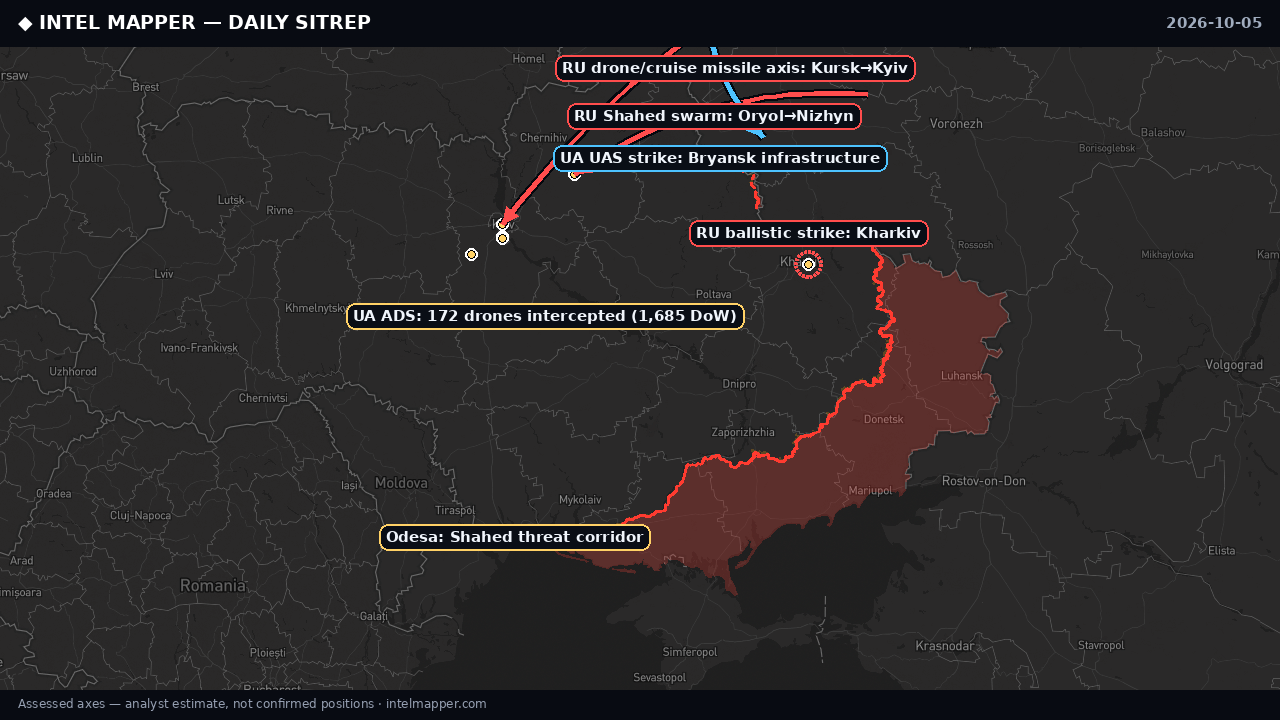
Key developments
- HTS forces expanded territorial control by ~11,435 km² in Aleppo and Al-Hasakeh governorates, consolidating dominance in northern Syria.
- Russia conducted 9,574 kamikaze drone operations against Ukraine in a 24-hour cycle, representing sustained intensive assault pressure.
- Ukrainian air defense intercepted/suppressed 172 Russian attack drones across multiple launch vectors targeting populated areas and infrastructure.
- Turkish-Saudi diplomatic engagement in Riyadh involved defense and foreign ministry officials, signaling continued regional military coordination.
- Russian ballistic missile strike on Kharkiv killed 1 civilian and injured 6, reflecting continuation of infrastructure-targeting campaign.
- Reported Israeli forces killed four individuals at Golan Heights security zone perimeter, maintaining border security posture.
- Ukrainian forces reportedly struck Russian energy infrastructure in Bryansk Oblast; damage and strategic effect assessment pending confirmation.
Middle East 6 tracked events
Hayat Tahrir al-Sham (HTS) forces continued significant territorial expansion across northern Syria on 5 October, adding approximately 1,582 km² in the Aleppo area and 9,853 km² in Al-Hasakeh according to updated conflict mapping. These gains represent sustained HTS advancement in consolidating control over formerly contested regions, building on previous territorial seizures. The scale of expansion in Al-Hasakeh is particularly notable given the historically contested nature of that governorate. Syrian Internal Security Forces are investigating a shooting incident in Tartous Governorate that killed two individuals, though circumstances remain under investigation. These developments underscore ongoing flux in Syrian territorial control.
Security incidents in the Golan Heights sector continued with reported Israeli forces killing four individuals described as "narco-terrorists" attempting to infiltrate a military position near Kafr Hawar in Quneitra Governorate. Israel maintains a designated security zone in this area following the 1974 disengagement agreement. Meanwhile, Turkey announced plans to integrate its domestically developed TF6000 engine into the KIZILELMA unmanned combat aircraft within coming months, signaling continued emphasis on military self-sufficiency and reducing import dependency. A Turkish diplomatic delegation led by Foreign Minister Hakan Fidan and Defence Minister Yaşar Güler met in Riyadh as part of the Mecca Alliance framework, though details of substantive outcomes remain limited.
The Middle East theatre reflects two parallel dynamics: internal Syrian territorial reconfiguration favoring HTS consolidation, and external military-diplomatic positioning by regional actors. Turkish advancement in indigenous defense systems, coupled with high-level diplomatic engagement in Riyadh, suggests ongoing regional coordination among Gulf and Turkish interests. The limited information regarding the Turkish-Saudi discussions prevents full assessment of their scope, though such meetings typically address shared security concerns including Yemen, Iraq, and broader regional balancing. Continued HTS territorial gains may reshape longer-term Syrian political dynamics.
- Two individuals killed in armed shooting incident in eastern Tartous Governorate. Syrian Internal Security For
- HTS forces expanded control (~1582 km²) in the Aleppo area per updated conflict control map.
- HTS forces expanded control (~9853 km²) in the Al-Hasakeh area per updated conflict control map.
- Turkey announced plans to integrate its domestically developed TF6000 engine into the KIZILELMA unmanned comba
- Turkish delegation led by Foreign Minister Hakan Fidan, Defence Minister Yaşar Güler, and Chief of Staff Orgen
- Israeli forces killed four narco-terrorists attempting to infiltrate a military position in southern Syria's G
Ukraine 12 tracked events
Russia's combined arms campaign against Ukraine sustained intensive pressure on 5 October, the 1,685th day of conflict. Ukrainian forces reported 177 combat clashes across the front, with Russian forces conducting 1 ballistic missile strike, 85 airstrikes delivering 245 guided bombs, 9,574 kamikaze drone operations, and 2,335 artillery barrages. These figures represent Russia's consistent operational tempo despite accumulated attrition. Ukrainian air defense systems intercepted or suppressed 172 Russian attack drones comprising Shahed variants, Gerbera drones, Banderol mini cruise missiles, and decoy systems launched from staging areas in Oryol, Kursk, Donetsk, and Crimea overnight on 4-5 October. A Russian ballistic missile struck Kharkiv's Industrialnyy District, killing one civilian and injuring six, with impacts on administrative and residential buildings.
Ukrainian air defense engaged multiple Russian strike packages directed at populated areas and infrastructure. Reported drone transits included 1 Shahed variant toward Kyiv Oblast from Kursk, 9 Shahed drones from the Black Sea targeting Odesa district, 15 Shahed drones passing Konotop toward Nizhyn, and three separate Banderol mini cruise missiles tracked toward central regions including Fastiv, Khodosivka, and Lisnyky. The geographic distribution and variety of Russian launch platforms indicate sustained coordination across multiple theater sectors. Ukrainian unmanned aerial vehicles reportedly struck Russian gas and electricity infrastructure facilities in Bryansk Oblast, though specific target confirmation and damage assessment remain absent.
The operational picture reflects Russia's emphasis on attrition through sustained drone and missile employment, targeting both military formations and civilian infrastructure to degrade Ukrainian capacity and morale. The scale of kamikaze drone deployment—nearly 10,000 over a 24-hour cycle—exceeds historical averages and suggests either increased production or deliberate surge operations. Ukrainian air defense's reported interception of 172 drones indicates maintained capability, though cumulative attrition of available systems may constrain future defensive density. Pentagon statements regarding globally positioned bomber readiness may reflect contingency planning messaging rather than imminent operational change, though such statements warrant monitoring for operational significance.
- Russian air defense (Igla MANPAD) shot down a Ukrainian FPV/Liutyi-type kamikaze drone near an oil refinery fa
- Russian missile strike on Kharkiv's Industrialnyy District killed 1, injured 6. Two-story administrative build
- Ukrainian air defense systems intercepted/suppressed 172 Russian attack drones (Shahed variants, Gerbera, Band
- Ukrainian General Staff reports 1,685th day of war. 177 combat clashes recorded. Russia conducted 1 ballistic
- Ukrainian air monitoring: 1 Russian Shahed-type drone from Kursk Oblast (Russia) toward Kyiv Oblast.
- Ukrainian air monitoring: 9 Russian Shahed-type drones from Black Sea toward Odesa district.
What to watch
Monitor for continuation or escalation of HTS territorial consolidation in northern Syria and potential responses from regional actors. In Ukraine theatre, observe whether Russia sustains current drone operational tempo or adjusts targeting strategy. Track Turkish-Saudi diplomatic outcomes regarding Mecca Alliance agenda and potential messaging on Iraq, Yemen, or Iran-related issues. Monitor Pentagon statements regarding bomber positioning for any escalatory indicators. Assess whether sustained Ukrainian infrastructure strikes against Russian targets elicit Russian response escalation. Track civilian casualty patterns in Russian missile strikes for potential strategic messaging shifts.