Ukraine sustains intense Russian assault; Greece bolsters NATO ties with $4B defense pact
Key developments
- Greece finalized $4 billion military equipment purchase with the United States, including Stryker vehicles, and joined the U.S. State Partnership Program.
- Russia conducted 224 combat engagements in Ukraine on Day 1688, deploying approximately 8,997 kamikaze drones and 74 airstrikes with 223 guided munitions.
- Russian forces reportedly captured Tsvitkove in Zaporizhzhia Oblast, continuing territorial progression in the southern theater.
- Syria's Foreign Ministry condemned Houthi attacks on Saudi infrastructure, reaffirming solidarity with the kingdom.
- Ukrainian air defense engaged Russian Geran-3 jet-powered drones over central Ukraine including Obukhiv.
Middle East 2 tracked events
The United States and Greece finalized a significant military cooperation agreement on October 8, with Greece committing to a $4 billion purchase of advanced defense equipment, including Stryker armored combat vehicles. Concurrently, Greece formally joined the U.S. State Partnership Program (SPP), a framework designed to strengthen bilateral military and security cooperation. This development reflects broader NATO consolidation in the Eastern Mediterranean and signals deepened U.S. commitment to regional allies amid ongoing strategic competition. The armored vehicle procurement specifically enhances Greece's capacity for rapid reaction and territorial defense, relevant to NATO's eastern flank presence.
In separate developments within the Levant, Syria's Foreign Ministry issued a formal statement condemning recent Houthi attacks directed against Saudi Arabian critical infrastructure and civilian targets. Damascus reaffirmed its stated solidarity with Saudi Arabia and expressed support for the kingdom's legitimate security interests. This public positioning, though single-sourced, suggests Syria's attempt to calibrate diplomatic messaging on regional conflict dynamics while maintaining rhetorical distance from non-state actors conducting strikes in the Arabian Peninsula. The statement's significance lies primarily in Damascus's effort to maintain workable relationships with Gulf actors despite broader regional polarization.
Middle East theater activity remained limited in reporting scope on October 8, with documented events focused on bilateral military arrangements and diplomatic posturing rather than direct kinetic escalation. The emphasis on Athens-Washington military coordination underscores NATO's ongoing capacity-building agenda among southeastern European members. Meanwhile, Syria's public condemnation of Houthi operations, regardless of underlying strategic calculus, represents conventional diplomatic positioning in a region where state actors navigate complex non-state actor networks and transnational security threats with competing interests.
Ukraine 3 tracked events
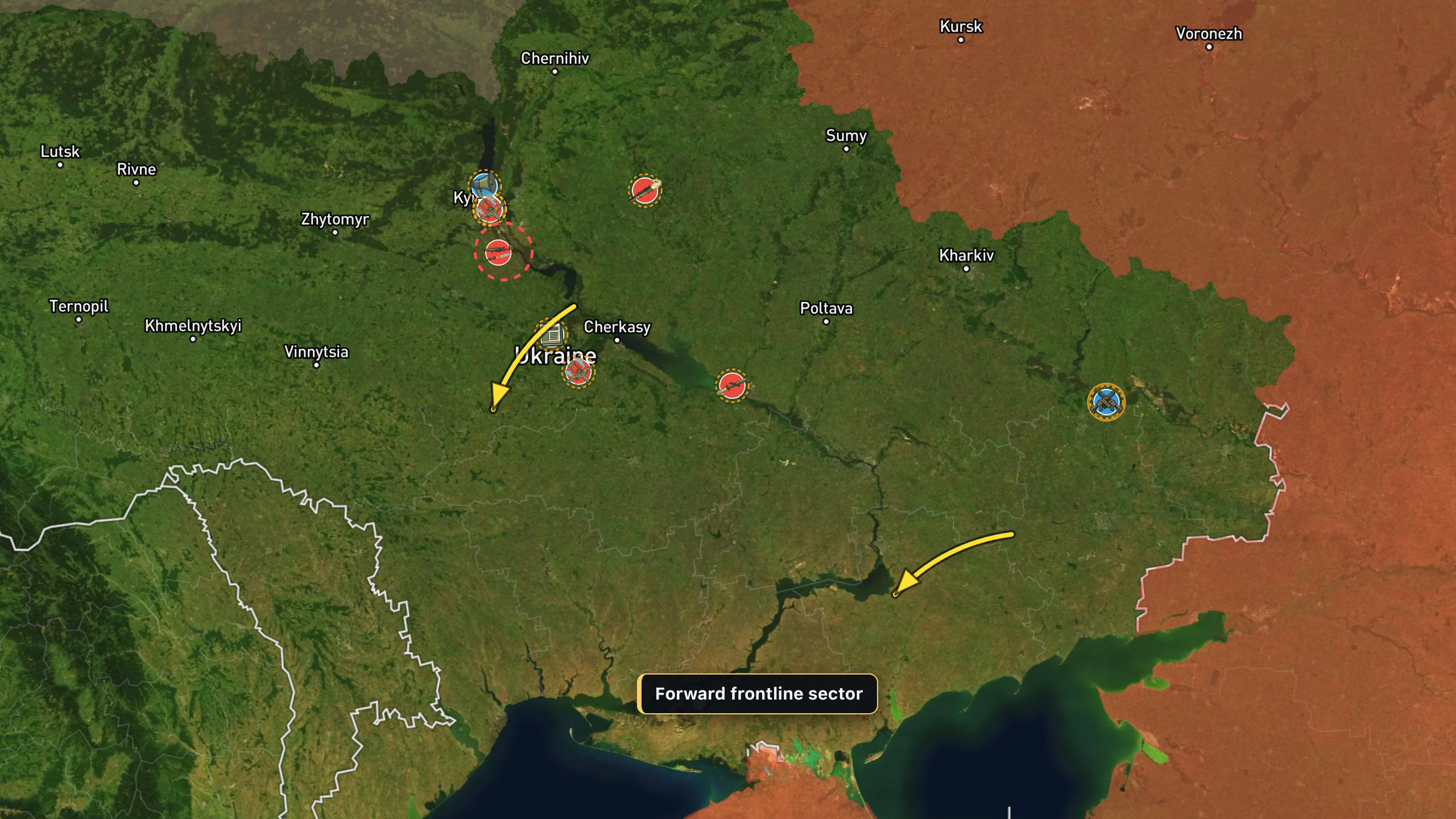
Ukraine experienced sustained high-intensity Russian offensive operations on October 8 (Day 1688 of the conflict), with the General Staff documenting 224 separate combat engagements across multiple fronts. Russian forces conducted one strategic missile strike, 74 separate airstrikes delivering 223 guided munitions, and deployed approximately 8,997 kamikaze drones during the 24-hour reporting period. Additionally, Russian forces reportedly executed 2,499 strikes targeting civilian settlements and infrastructure. These figures, consistent with recent operational tempos, underscore Russia's continued reliance on attrition-based tactics combining aerial bombardment, unmanned systems saturation, and ground assault.
Territorial changes registered on October 8 included Russian capture of Tsvitkove in Zaporizhzhia Oblast, according to frontline monitoring sources. This represents incremental Russian territorial advancement in the southern theater, consistent with Moscow's grinding offensive strategy in that sector. Ukrainian air defense systems reported engagement with Russian Geran-3 (Shahed variant) jet-powered drone systems over populated areas including Obukhiv, indicating continued Russian ISR and strike drone operations. The persistence of high drone sortie rates suggests Russian willingness to sustain attrition in unmanned systems as part of broader degradation strategy against Ukrainian defensive capacity.
The operational picture reflects no significant change in conflict trajectory on October 8. Russian forces maintained intensive combined-arms pressure across multiple fronts while Ukraine conducted defensive operations and air interception missions. The scale of Russian kinetic operations—particularly drone deployment rates exceeding 8,000 daily—continues to impose substantial logistical demands on Ukrainian air defense and emergency response systems. Territorial gains remain marginal relative to Russian force expenditure, consistent with the conflict's established pattern of incremental Russian advancement at high cost.
- Ukrainian air monitoring: 1 Russian jet-powered Shahed (Geran-3) drone circling over Obukhiv.
- Ukrainian General Staff operational summary: 224 combat clashes reported on Day 1688. Russia conducted 1 missi
- Tsvitkove, Zaporizhzhia Oblast, Ukraine reported captured by Russian forces (per DeepStateMAP frontline update
What to watch
Monitor the intensity and geographic distribution of Russian drone and missile strikes over the next 48 hours; assess whether high sortie rates continue or decline. Track Ukrainian counteroffensive capabilities and any documented shifts in frontline positions across Zaporizhzhia, Donetsk, and northern sectors. Observe whether Greece's military agreement generates NATO-wide procurement coordination or signals broader alliance modernization timelines. Watch for Houthi operational tempo and Saudi/regional response statements. Monitor for any escalation in U.S.-Syria or Russia-Syria diplomatic activity.