Ukraine reports 131 Russian drones intercepted in overnight attack on Kyiv region
What happened
Ukrainian air defense reportedly intercepted 131 Russian attack drones during an overnight assault on October 2–3, according to the General Staff. The attack involved Shahed cruise drones, including 45 jet-powered variants, Geran drones, and decoy units launched from four directions: Bryansk and Primorsko-Akhtar in Russia, and occupied Donetsk and Crimea. Ukrainian aviation, air defense systems, electronic warfare units, and mobile fire groups conducted the defense. As of 09:00 on October 3, impacts were confirmed at 12 locations, with debris from intercepted drones falling at five additional sites.
Context and assessment
The attack represents the latest in a sustained Russian campaign targeting Kyiv and its surroundings with long-range drones and missiles. A captured operational plan dated October 2 reportedly outlined Russian plans to escalate with up to 1,000 munitions throughout winter, targeting critical infrastructure including power and water systems. The previous day saw Russian airstrikes killing one person and wounding two in Kyiv, while earlier October 2 activity included detection of two reactive Shahed variants transiting toward the city. The scale and composition of this attack—emphasizing kamikaze drones supplemented by decoys—suggests Russian efforts to overwhelm Ukrainian air defenses through volume and saturation tactics, a pattern increasingly common in the conflict.
Sources and confidence
Reported by the Ukrainian General Staff via Telegram (@GeneralStaffZSU) at 09:00 UTC on October 3. This is the sole source in the provided data, giving a single-channel assessment. The confidence score of 8.0 reflects the authoritative nature of the General Staff as a primary official source, though independent corroboration of the 131-drone figure from international monitors or other sources would strengthen confidence. Real-time interception claims during active attacks are difficult to verify independently until post-attack analysis.
Location
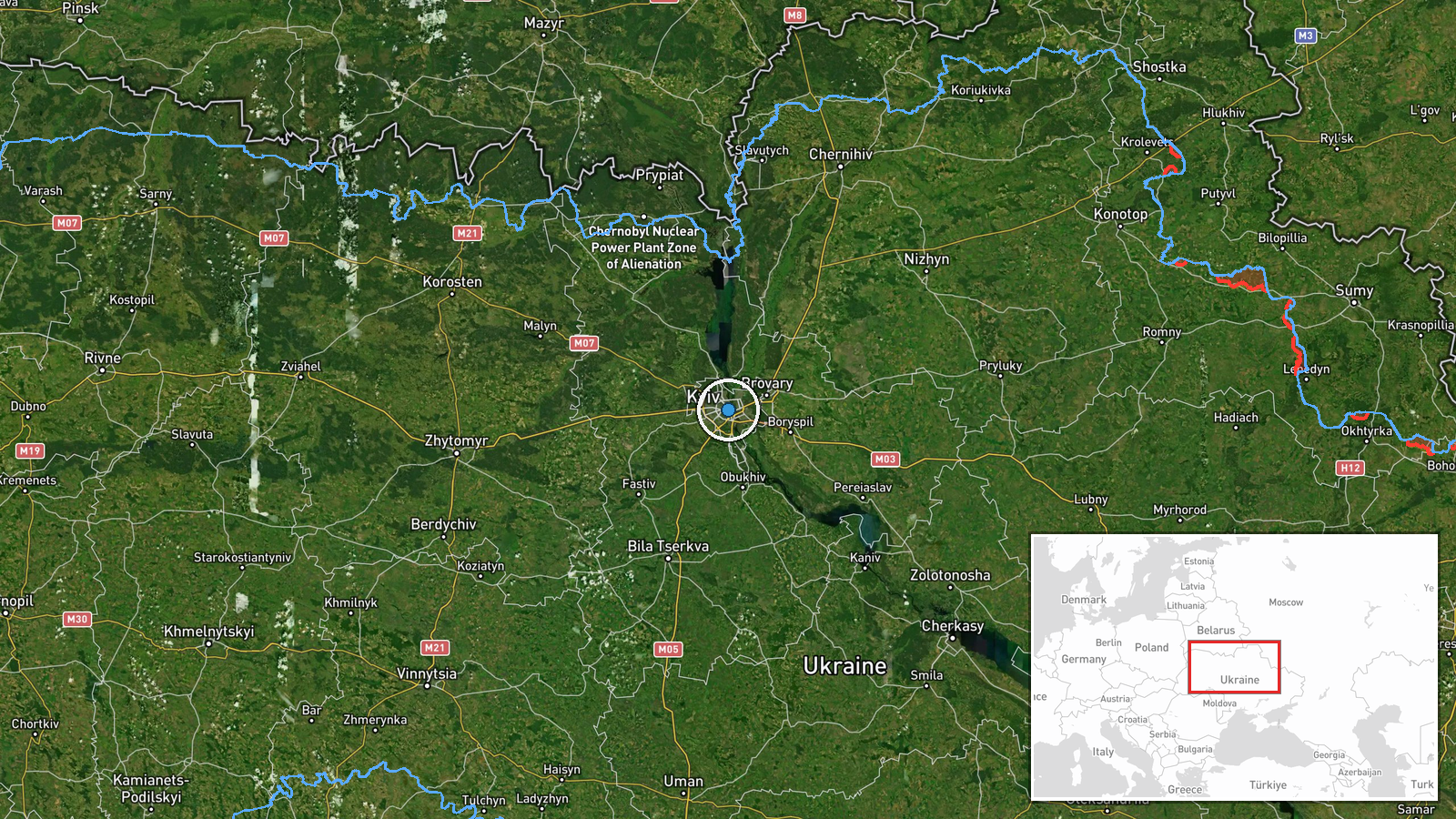
Kyiv and Kyiv Oblast, determined at regional precision level based on the reported attack footprint. The Kyiv metropolitan area sits on the Dnieper River in north-central Ukraine, approximately 100 kilometers south of the Belarus border and roughly 400 kilometers northwest of the front lines. The region's importance as Ukraine's capital and primary population center makes it a recurring target for Russian long-range strike campaigns.
Related events nearby
- A courier was forcibly conscripted in Kyiv. Video evidence documented the arrest and military recruitment acti2026-10-02 15:29 UTC · Security · Kyiv, Kyiv City, Ukraine
- Russian airstrike on Kyiv killed one person and injured two others, according to city authorities.2026-10-02 09:20 UTC · Airstrike · Kyiv, Kyiv Oblast, Ukraine
- Two Russian Shahed-variant reactive (jet-powered) kamikaze drones tracked transiting toward Kyiv from north an2026-10-02 08:01 UTC · Drone Transit · Kyiv, Kyiv Oblast, Ukraine
- Russian air forces struck Kyiv's Pivdennyi Bridge (Southern Bridge), a critical crossing over the Dnieper Rive2026-10-02 15:08 UTC · Airstrike · Southern Bridge (Pivdennyi Most), Kyiv, Ukraine
- One reactive (jet-propelled) Shahed-variant drone detected transiting Brovary district, Kyiv Oblast. No impact2026-10-03 03:37 UTC · Drone Transit · Brovary, Kyiv Oblast, Ukraine
▶ View this event on the live map
Intel Mapper aggregates open-source reports from monitored Telegram and X channels, geolocates them, cross-checks duplicates across sources and assigns a confidence score. Entries are updated as new confirmations arrive. Read how we verify events.