Ukrainian monitoring reports one jet-powered Shahed (Geran-3) drone heading toward Korosten
What happened
On 22 October 2026, at about 16:58 UTC, a Telegram channel attributed to Ukraine's air monitoring service (@kpszsu) reported a single jet-powered Shahed-type drone, identified as Geran-3, moving toward the settlement of Korosten in Zhytomyr Oblast, northwestern Ukraine. The original post is in Ukrainian and reads, in translation, roughly as 'Zhytomyr region: jet-powered UAV heading toward the settlement of Korosten.' The post is a brief track alert. It does not describe impact, damage, casualties, or whether the drone was intercepted. The report is attributed to Russia as the likely launching party, a judgment based on the drone type and the context of the wider campaign rather than on a direct statement of origin in the alert.
Context and assessment
Korosten is a rail and road junction in northwestern Zhytomyr Oblast, and that infrastructure makes it a plausible secondary target in a long-range strike campaign against transport and logistics nodes. The alert sits within a cluster of Geran-3 transit reports in the same oblast over roughly 24 hours. Earlier that day, at 07:18 UTC, a drone was reported passing Zon toward Zhytomyr Oblast. At 07:19 UTC another was reported passing Ovruch heading west, and at 16:57 UTC a drone was reported heading toward Zhytomyr city, about a minute before the Korosten alert. On the previous evening, at 18:25 UTC on 21 October, two or more drones were reported passing northern Zhytomyr Oblast heading west. The pattern suggests multiple airframes moving through or across the oblast on different routes, with some tracks moving west and others heading toward urban centers. The alerts do not confirm that the tracks belong to a single coordinated raid, and the reports may partly describe the same airframes seen at different points. Operationally, the sequence may indicate routing through northern Ukraine toward western or northwestern targets, with Korosten lying along that corridor. Jet-powered variants are generally faster than the older piston-engine Shahed models, which would shorten warning times for ground-based air defenses.
Sources and confidence
The event rests on one source, a Telegram channel attributed to Ukraine's air monitoring service. No second independent outlet, official regional statement, or wire report is recorded in the data, and the event has not been corrected. The confidence score of 8.0 reflects a credible official channel with a precise timestamp and a specific settlement named, offset by the single-source basis and the absence of any confirmation of impact or interception. Confidence would rise if regional military administrations, other monitoring channels, or independent observers corroborated the track, or if a follow-up report described the drone's fate. It would fall if the track were revised, if the drone were later described as a different type, or if subsequent reports showed the alert was superseded.
Location
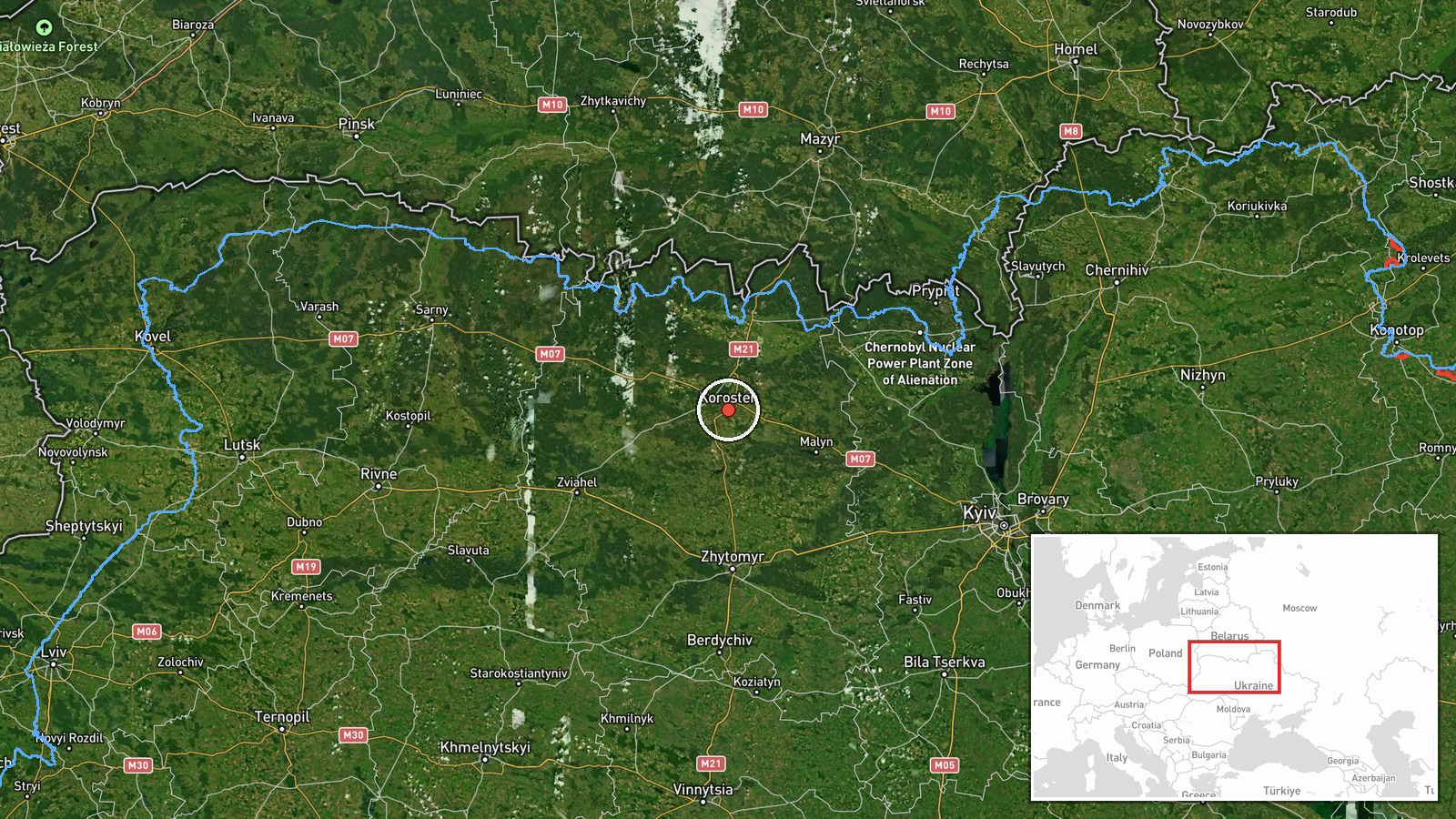
The location is recorded at settlement precision for Korosten, with high location confidence. The coordinates, about 50.95 N and 28.64 E, correspond to the town center rather than to any specific facility, and the alert names only the settlement. Korosten sits in the Polissia lowlands of northwestern Ukraine, a region of forests, marshland, and river valleys. The Teteriv River runs through the town. The area is about 70 to 80 kilometers north of Zhytomyr city and relatively close to the border with Belarus, which is part of the broader northern corridor used in several recent strike routes.
Related events nearby
- Ukrainian air monitoring: 2+ Russian jet-powered Shahed (Geran-3) drones passing Korosten, heading west.2026-10-22 17:30 UTC · Drone Transit · Korosten, Ukraine
- Ukrainian air monitoring: 1 Russian jet-powered Shahed (Geran-3) drone heading toward Korosten.2026-10-22 08:09 UTC · Drone Transit · Korosten, Ukraine
- Ukrainian air monitoring: 2+ Russian jet-powered Shahed (Geran-3) drones passing northern Zhytomyr Oblast, hea2026-10-22 17:54 UTC · Drone Transit · northern Zhytomyr Oblast, Ukraine
- Ukrainian air monitoring: 2+ Russian jet-powered Shahed (Geran-3) drones passing northern Zhytomyr Oblast, hea2026-10-21 18:25 UTC · Drone Transit · northern Zhytomyr Oblast, Ukraine
- Ukrainian air monitoring: 1 Russian jet-powered Shahed (Geran-3) drone passing Ovruch, heading west.2026-10-22 07:19 UTC · Drone Transit · Ovruch, Ukraine
▶ View this event on the live map

Intel Mapper aggregates open-source reports from monitored Telegram and X channels, geolocates them, cross-checks duplicates across sources and assigns a confidence score. Entries are updated as new confirmations arrive. Read how we verify events.