Two Russian Shahed-variant drones detected transiting toward Kremenchuk reservoir
What happened
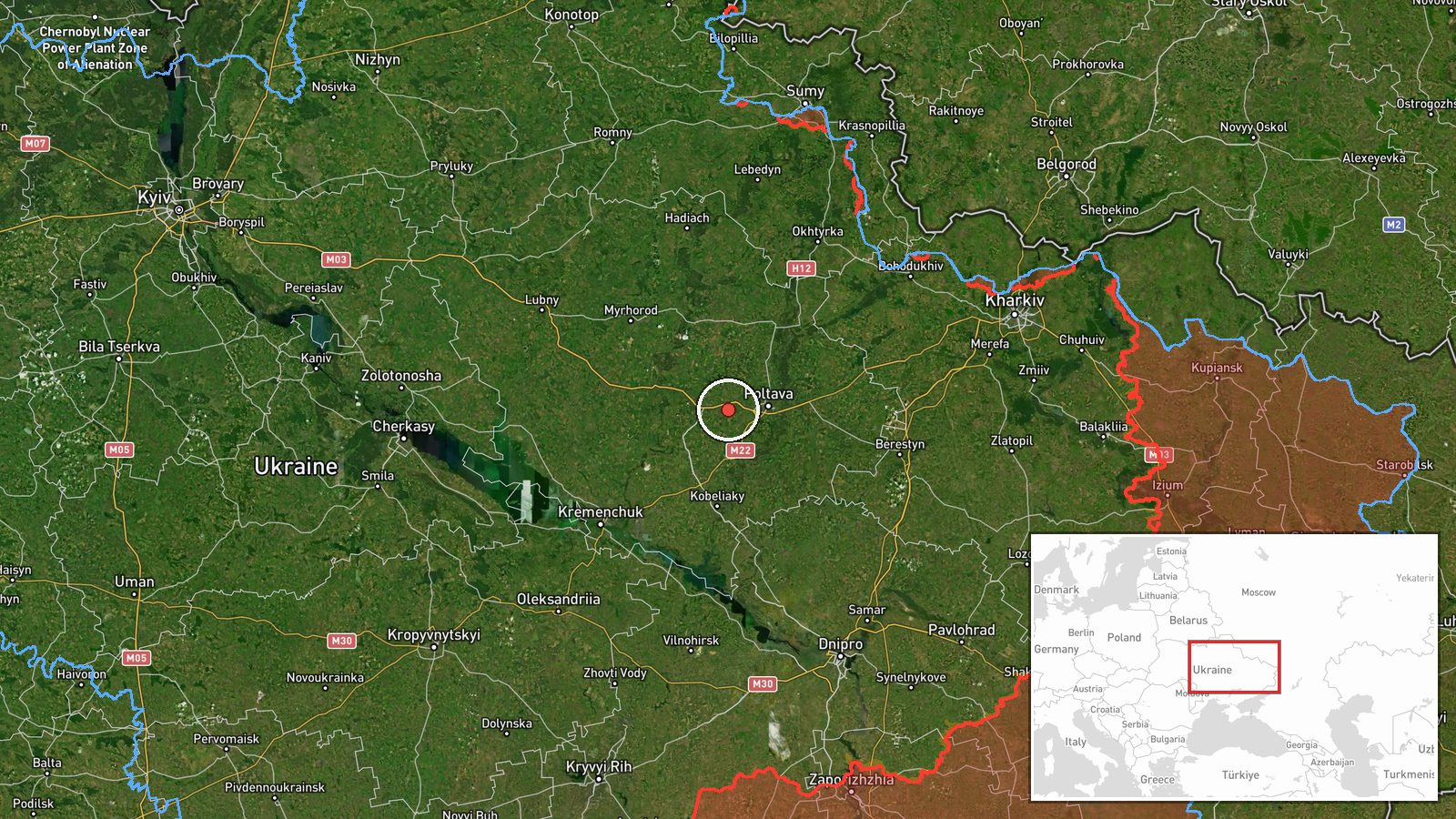
Two Russian reactive kamikaze drones of Shahed-variant type were detected in flight heading toward Kremenchuk Water Reservoir in Poltava Oblast on September 4 at 23:05 UTC. The drones were tracked in transit; no impact or interception has been reported at the time of this account. The source, Telegram channel @war_monitor, provided the initial alert using Ukrainian-language notation indicating reactive-powered vectors toward the Kremenchuk area.
Context and assessment
Kremenchuk Water Reservoir serves as both a water supply and industrial asset in central Ukraine. The detection occurs within a broader series of Russian drone strikes across Poltava and neighboring oblasts on September 4, including a confirmed destruction of a Ukrainian 35D6 air defense radar system earlier that evening. A wave of at least twelve Geran-2 drones was detected transiting through Sumy Oblast toward Poltava, and multiple other Shahed-variant drones have been tracked across Dnipropetrovsk and Cherkasy oblasts. The pattern suggests a coordinated multi-vector drone campaign, possibly following suppression of air defense assets to enable deeper penetration of Ukrainian airspace.
Sources and confidence
Single source: Telegram channel @war_monitor. No cross-confirmation from independent channels or official Ukrainian sources reported. Confidence score of 6.0 reflects typical reliability of volunteer monitoring channels but limited corroboration. Confirmation of impact or air defense response would raise confidence; failure to report any detonation or loss of the drones would lower confidence in detection accuracy.
Location
Kremenchuk Water Reservoir, located in Poltava Oblast at approximately 49.57°N, 34.27°E. The reservoir lies adjacent to the city of Kremenchuk, a significant industrial center on the Dnipro River. Geo-precision marked as settlement level based on named geographic feature. The location sits in central-eastern Ukraine, roughly 300 kilometers southeast of Kyiv.
Related events nearby
- Russian Geran-2 (Shahed-136) kamikaze drone destroyed a Ukrainian 35D6 air defense radar system. The radar was2026-09-04 22:37 UTC · Drone Shootdown · Poltava Oblast, Ukraine
- Twelve Russian Geran-2 (Shahed-136) kamikaze drones detected transiting through Okhtyrka District, Sumy Oblast2026-09-04 21:11 UTC · Drone Transit · Okhtyrka District, Sumy Oblast, Ukraine
- Russian ballistic missile strike reported on Kamyanske, Dnipropetrovsk Oblast. Fourth alert of ballistic missi2026-09-04 22:24 UTC · Ballistic Missile · Kamyanske, Dnipropetrovsk Oblast, Ukraine
- Two Russian reactive (jet-powered) Shahed-variant kamikaze drones detected transiting through Dnipropetrovsk O2026-09-04 22:45 UTC · Drone Transit · Samar, Dnipropetrovsk Oblast, Ukraine
- Russia conducted overnight (4-5 Sept) mass drone and missile attack on Ukraine. Attack included 5× KN-23 balli2026-09-05 05:50 UTC · Ballistic Missile · Ukraine, nationwide attack (multiple oblasts)
▶ View this event on the live map
Intel Mapper aggregates open-source reports from monitored Telegram and X channels, geolocates them, cross-checks duplicates across sources and assigns a confidence score. Entries are updated as new confirmations arrive. Read how we verify events.