Russian ballistic missile transits Chernihiv Oblast toward Kyiv region
What happened
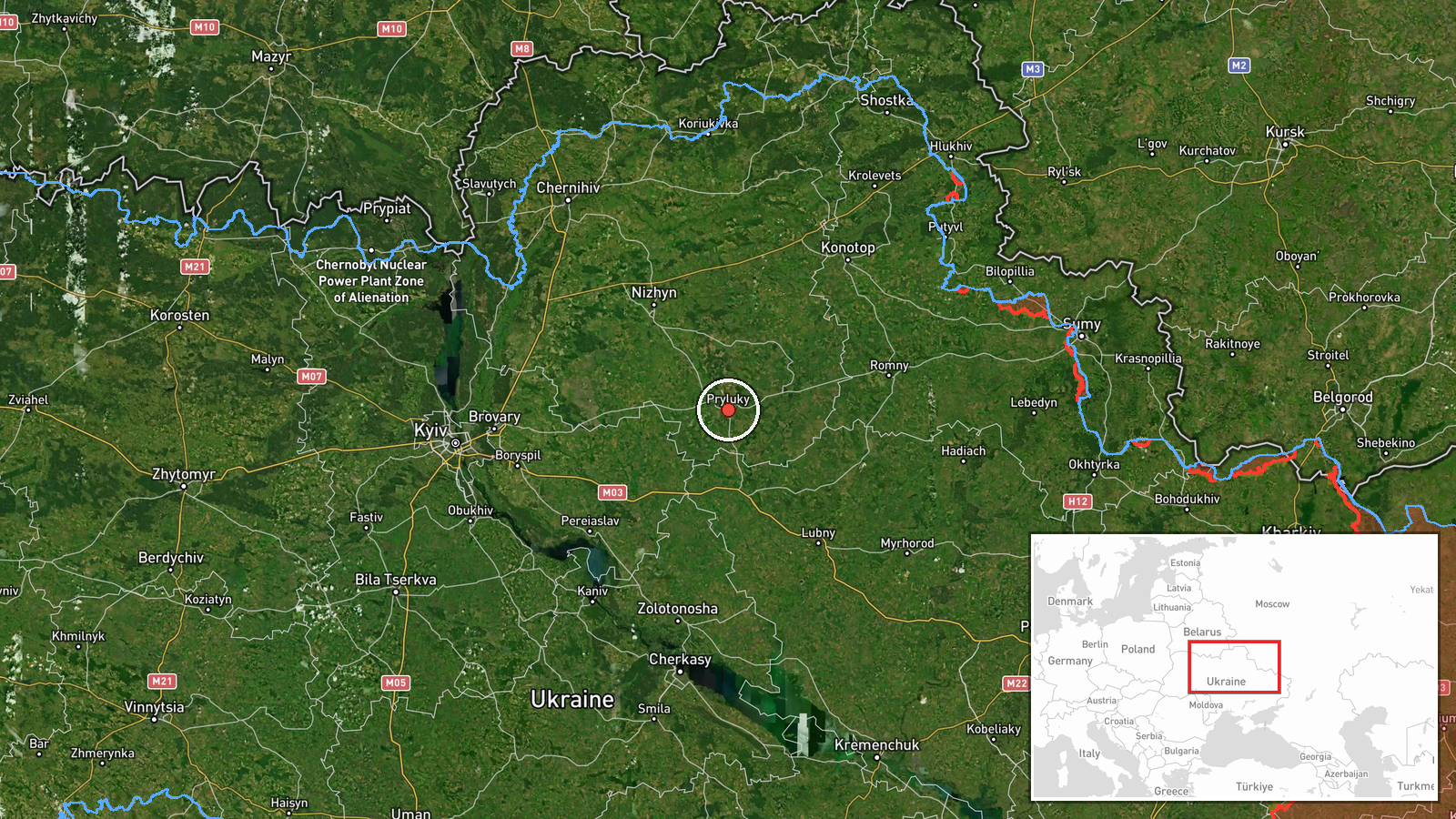
A single Russian ballistic missile, reportedly of Iskander or Kinzhal type, was detected passing over Pryluky in Chernihiv Oblast on October 3 at approximately 18:22 UTC, on a trajectory toward targets in Kyiv region. The missile transit was reported by the Telegram channel @war_monitor. No immediate impact details were provided in the available report.
Context and assessment
Pryluky lies along a northern approach corridor to Kyiv, approximately 170 kilometers northeast of the capital. This missile transit occurred as part of a broader Russian strike campaign on October 3, which included cruise missile activity detected over Nizhyn and Konotop earlier that morning, followed by another ballistic missile overflying Barishivka in Kyiv Oblast minutes after this report. Ukrainian air defenses had intercepted 131 attack drones the previous night. The convergence of multiple missile and drone vectors toward Kyiv region on this date suggests a coordinated multi-axis strike effort, typical of recent Russian operational patterns targeting the capital and surrounding regions.
Sources and confidence
Reported by Telegram channel @war_monitor with no stated cross-confirmation from other open sources as of reporting. Single-source reporting lowers confidence to 6.0 out of 10. Confidence would increase with Ukrainian official air defense statements, satellite imagery, or corroborating reports from other established monitoring channels. Missile type assessment relies on trajectory and typical Russian system deployment patterns rather than direct identification.
Location
Pryluky is a town in Chernihiv Oblast, approximately 170 kilometers northeast of Kyiv. Located at 50.595°N, 32.387°E, it sits in Ukraine's northern region along transport and infrastructure corridors frequently used by Russian strikes. Geo-precision is regional rather than point-specific. The location was identified by the monitoring channel as the observation point for missile transit, not necessarily the impact location.
Related events nearby
- Four Russian subsonic cruise missiles (Kh-47/UMPC-5 'Banderol' variants) detected en route toward Nizhyn, Cher2026-10-03 06:56 UTC · Cruise Missile · Nizhyn, Chernihiv Oblast, Ukraine
- One Russian ballistic missile (likely Iskander/Kinzhal) transited over Barishivka with westward vector toward 2026-10-03 18:28 UTC · Ballistic Missile · Barishivka, Kyiv Oblast, Ukraine
- Two Russian subsonic cruise missiles (Kh-47/UMPC-5 'Banderol' variants) detected en route toward Konotop, Sumy2026-10-03 06:51 UTC · Cruise Missile · Konotop, Sumy Oblast, Ukraine
- One reactive (jet-propelled) Shahed-variant drone detected transiting Brovary district, Kyiv Oblast. No impact2026-10-03 03:37 UTC · Drone Transit · Brovary, Kyiv Oblast, Ukraine
- Ukrainian air defense intercepted 131 Russian attack drones (Shahed, Geran, decoys) launched from four directi2026-10-03 06:24 UTC · Air Defense · Kyiv, Kyiv Oblast, Ukraine
▶ View this event on the live map
Intel Mapper aggregates open-source reports from monitored Telegram and X channels, geolocates them, cross-checks duplicates across sources and assigns a confidence score. Entries are updated as new confirmations arrive. Read how we verify events.