Saudi Aramco hit amid escalating Yemen-Saudi cycle; Ukraine absorbs sustained Russian air campaign
Key developments
- Ballistic missile struck Saudi Aramco headquarters in Dhahran; Saudi air defense intercepted but debris caused civilian impact and fires, escalating Houthi-Saudi cycle.
- Houthi forces executed precision targeting strategy after publicly naming three Saudi strategic sites; coalition responded with airstrikes on Sana'a petroleum and missile infrastructure.
- Israeli PM Netanyahu reportedly discussed resuming Iran military strikes with Trump, who reportedly encouraged preparation; Defense Minister warned Iran of severe consequences for election-period attacks.
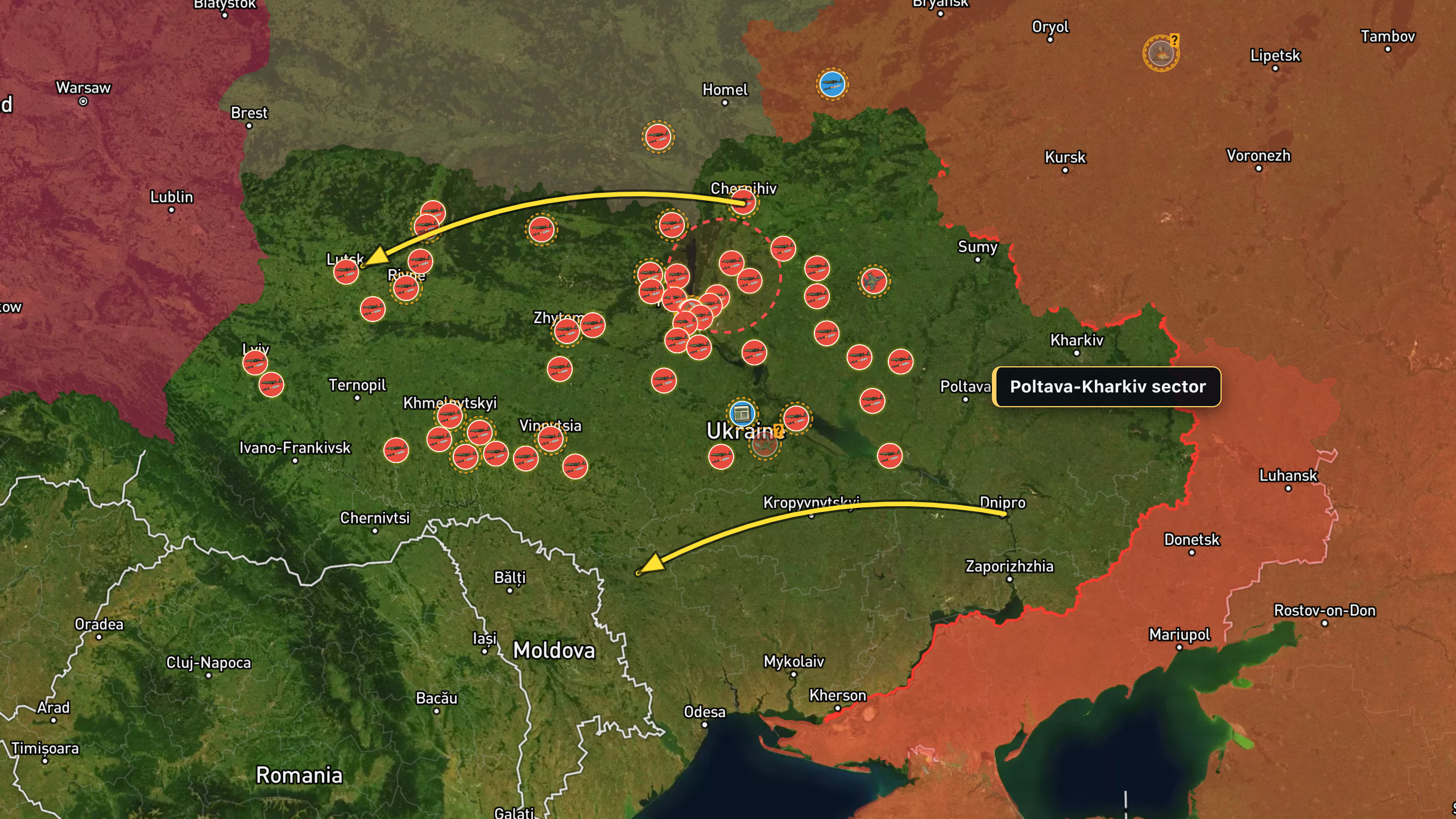
- Russian forces deployed 5,602 kamikaze drones, 66 airstrikes, and ballistic missiles in 24-hour campaign; Zelenskyy alleged Western partners withheld advance intelligence, triggering U.S. intelligence-sharing threat.
- Ukrainian forces claimed stabilization of multiple frontline sectors through counter-attacks despite 206 reported clashes; Russian advances in Shakhove sector measured at ~6 km² without settlement gains.
- Unidentified projectile struck tanker in Strait of Hormuz; Iran's IRGC Navy commander threatened to sink U.S. warships while denying RAF Fairford attack allegations to British ambassador.
- Turkey and Egypt pledged unconditional support to Saudi Arabia; Syria condemned Iranian and Houthi actions; NATO-Turkey PASSEX exercise conducted in Eastern Mediterranean amid regional tensions.
Middle East 30 tracked events
A ballistic missile struck Saudi Aramco headquarters in Dhahran on 13 October, with Saudi air defenses intercepting the weapon but debris impacting residential areas and triggering fires and evacuations. The strike followed credible Houthi threats naming three specific Saudi targets—Aramco facilities in Dammam and Riyadh, and King Khalid International Airport—in retaliation for coalition airstrikes on Sana'a oil infrastructure. Saudi-led coalition warplanes conducted multiple strikes on Houthi-controlled missile and petroleum facilities in Sana'a, including Yemen Petroleum Company's Al-Sabaha Central Station. This pattern reflects an established cycle of Houthi drone and missile attacks against Saudi infrastructure, met by coalition airstrikes on Houthi military and economic targets in Yemen.
Air traffic disruptions persisted at Jeddah's King Abdulaziz International Airport, with aircraft diverting following days of Houthi attacks on Saudi aviation infrastructure. Saudi air defense systems intercepted three drones north of Riyadh, adding to the documented toll of Houthi unmanned systems. The Strait of Hormuz recorded an incident in which an unidentified projectile struck a tanker, with UK Maritime Trade Operations confirming the event and vessels advised to exercise caution—illustrating the broader maritime risk posed by regional escalation. These attacks underscore Houthi capability to sustain multi-vector pressure on Saudi economic and strategic nodes despite coalition countermeasures.
Political statements reinforced emerging alignments and deterrence messaging. Turkish President Erdoğan offered Saudi Arabia unconditional support against Houthi attacks; Egypt's Foreign Minister pledged all forms of assistance, citing threats to Suez Canal security from Houthi control of Bab el-Mandeb; Syria's Foreign Minister condemned Iranian and Houthi attacks as destabilizing to regional security. Israeli Defense Minister Israel Katz warned Iran and proxies of severe consequences for attacks aimed at influencing Israeli elections, while Netanyahu reportedly discussed resuming military strikes against Iran with U.S. President Trump, who reportedly encouraged preparation for such action. These statements signal hardening positions across multiple state actors and anticipated escalatory potential.
- Ballistic missile struck Saudi Aramco headquarters in Dhahran, Eastern Province. Saudi air defense intercepted
- Israeli PM Netanyahu discussed with U.S. President Trump a possible resumption of military strikes against Ira
- PM Netanyahu at Seam Line in Samaria warns adversaries Israel is prepared for any scenario and possesses unmat
- Houthi (Ansar Allah) issues evacuation warnings for King Khalid International Airport in Riyadh and Saudi Aram
- Saudi-led coalition warplanes conducted airstrikes on Houthi-controlled missile and oil facilities in Sana'a,
- Saudi-led coalition airstrikes targeting Yemen Petroleum Company's Al-Sabaha Central Station in Sana'a. Houthi
Ukraine 30 tracked events
Russian forces sustained a major air campaign against Ukraine on 13 October, deploying 5,602 kamikaze drones, conducting 66 airstrikes, and launching at least one ballistic missile toward Kyiv according to Ukrainian air monitoring. Ukrainian President Zelenskyy stated that Western partners provided no advance intelligence of the massive Russian attack on Kyiv the previous night, and confirmed Ukraine has voluntarily refrained from escalatory strikes. A U.S. threat to cut intelligence sharing with Ukraine followed Zelenskyy's public criticism of insufficient warning, signaling possible friction in the alliance relationship over intelligence coordination. Ukraine conducted a large-scale drone attack on Russian military assets and occupied territories, though specific targets remained unreported at the time of this summary.
Ukrainian General Staff reported 206 combat clashes across all sectors on 13 October (22:00 local), with the Pokrovsk axis remaining the primary Russian concentration of force. Russian forces advanced approximately 6 km² in the Shakhove sector without seizing settlement centers, per DeepState frontline mapping. Former Ukrainian military commander Oleksandr Syrskyi claimed Ukrainian forces had stabilized the frontline across most sectors through counter-attacks, reducing Russian offensive momentum. The scale of Russian drone deployment—over 5,600 in a single operational period—reflects sustained industrial capacity for unmanned systems and indicates a shift toward attrition warfare combining drone strikes, artillery, and ground advances.
Ukrainian air defense remained under pressure, with drone transits tracked across multiple oblasts including Kyiv, Zhytomyr, Khmelnytskyi, Vinnytsia, and Zaporizhzhya regions. Russian jet-powered Shahed (Geran-3) drones and tactical aircraft maintained coverage of dispersed targets across western and central Ukraine. The concentration of drone attacks on cities and infrastructure, combined with ballistic missile strikes and artillery saturation, suggests Russian strategy aims to degrade Ukrainian civilian morale, disrupt economic activity, and strain air defenses before anticipated ground operations. Ukrainian ability to execute reciprocal drone strikes indicates operational resilience despite the asymmetric scale of Russian air bombardment.
- Ukrainian President Zelenskyy states Ukraine received no advance intelligence from Western partners about a ma
- Ukrainian air monitoring: 1 Russian jet-powered Shahed (Geran-3) drone heading toward Sarny.
- Ukrainian air monitoring: 1 Russian jet-powered Shahed (Geran-3) drone heading toward Kozelets; 1 Russian jet-
- Ukrainian air monitoring: 2+ Russian jet-powered Shahed (Geran-3) drones from Kirovohrad Oblast toward Teplyk.
- Ukrainian air monitoring: 1 Russian ballistic missile heading toward Kyiv.
- Ukraine conducted a large-scale drone attack targeting Russian military assets and Russian-occupied territorie
What to watch
Monitor the next 24-48 hours for: (1) additional Houthi strikes on named Saudi targets or expansion of attack vectors; (2) escalation of Israeli-Iranian tensions around election period, including possible Israeli strike authorization; (3) Russian exploitation of any temporary Ukrainian air defense saturation points along Pokrovsk axis; (4) Western intelligence coordination statements clarifying U.S.-Ukraine intelligence-sharing status; (5) maritime incident patterns in Hormuz and Arabian Sea suggesting coordinated Iranian proxy activity; (6) Saudi civil defense protocols following reports of halted public warnings before October attacks. Regional air traffic disruptions and drone transit density warrant continued monitoring for civilian impact patterns.