UK Typhoons to Saudi Arabia as Hormuz incidents and US naval buildup continue
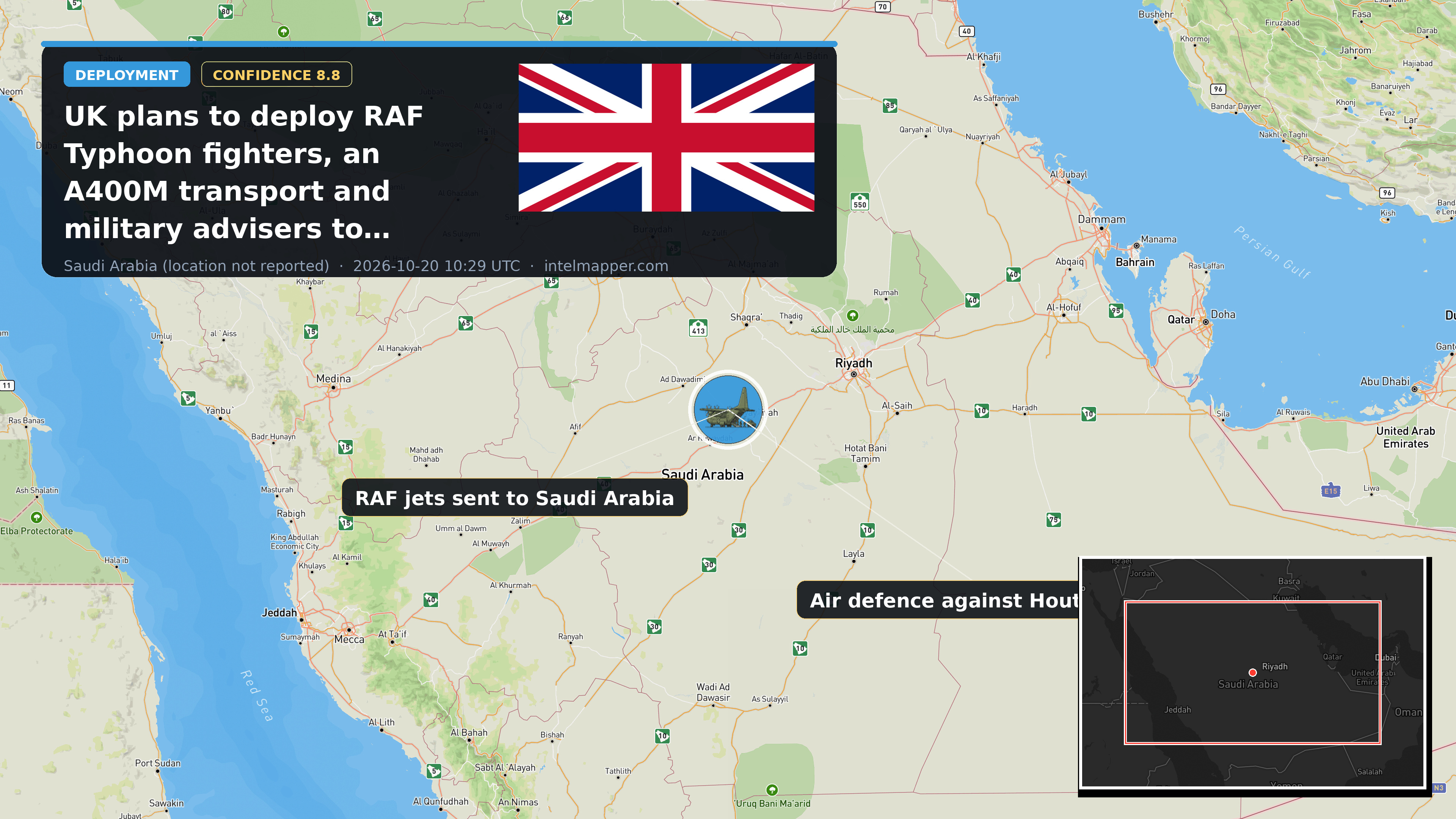
- UK approves Typhoons, A400M and advisers for Saudi Arabia.
- Saudi air defence intercepts Houthi missile aimed at Riyadh.
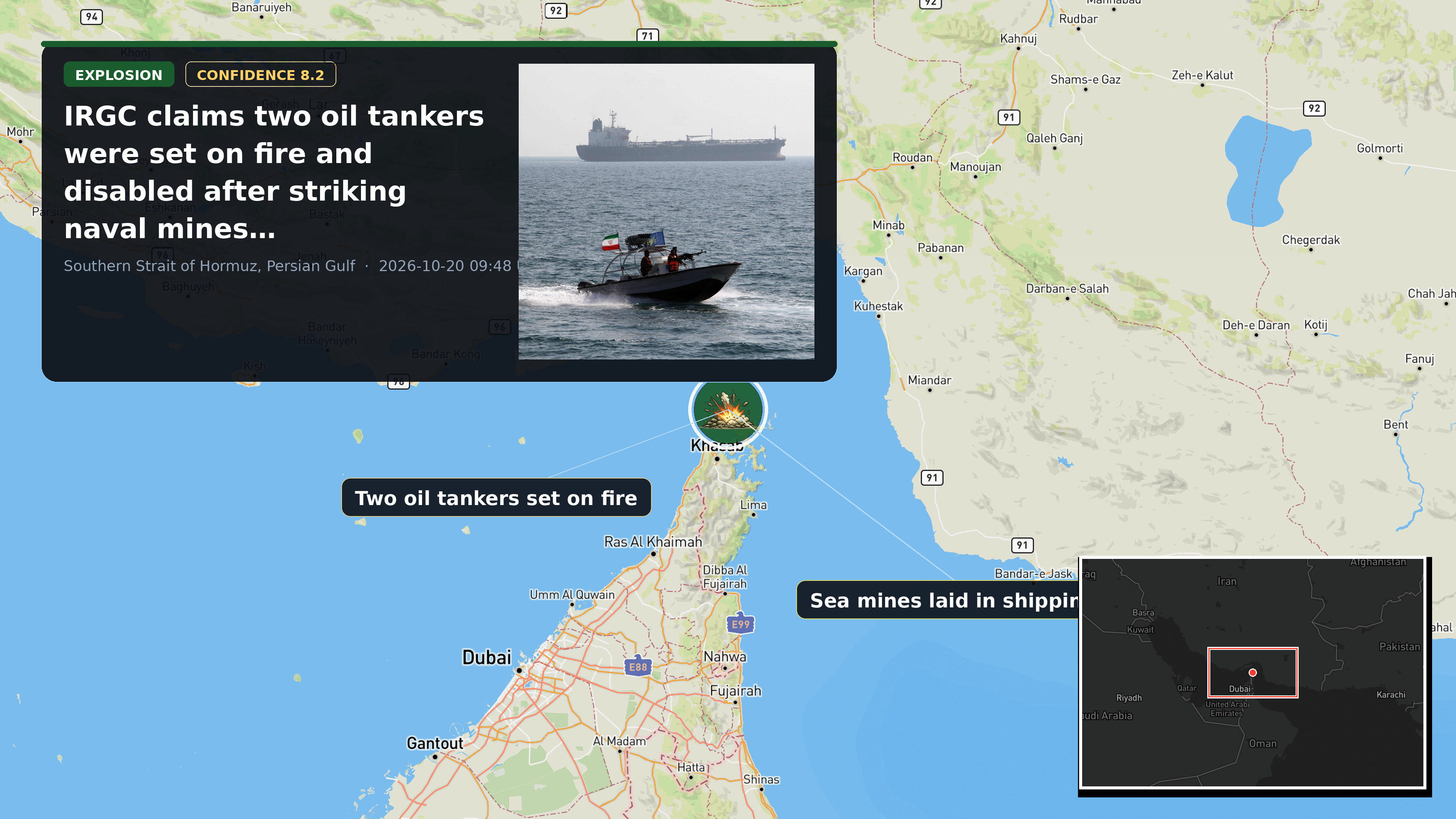
- IRGC claims two tankers disabled by mines in Hormuz.
- IRGC claims downing of US MQ-9 drone, unverified.
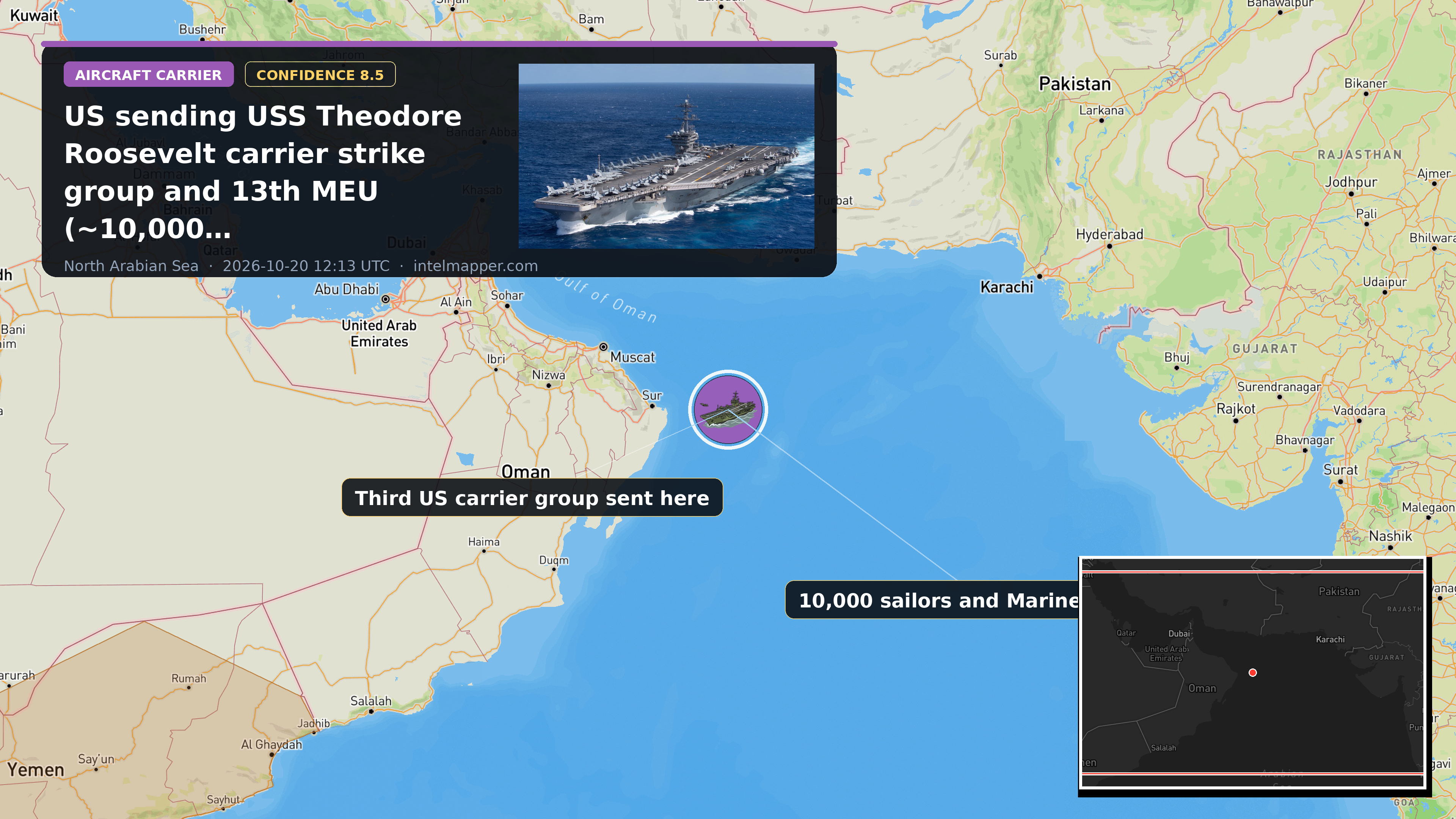
- USS Theodore Roosevelt group heading to Arabian Sea by November.
What to watch: Over the next 24 to 48 hours, attention should focus on whether the Oslo talks produce a published framework or a further round of meetings, and whether Finnish and Norwegian hosts provide details.
Full analysis (700 words)
The most consequential development in the Middle East theatre was the Houthi escalation against Saudi Arabia. The UK approved a deployment of RAF Typhoon fighters, an A400M transport aircraft and military advisers to Saudi Arabia after a Saudi request, adding to planned refuelling support. The move follows Houthi attacks on cities and infrastructure. The Saudi military said it intercepted a Houthi ballistic missile aimed at Riyadh, and air raid alerts sounded in the capital before the interception. Separately, Iran's Foreign Ministry spokesman Esmail Baghaei rejected possible Egyptian military support for Saudi Arabia, warning that further intervention would worsen the Yemen conflict and urging dialogue under the existing roadmap. Taken together, the day's reporting shows the Yemen front drawing in additional external actors, with Riyadh's air defence demands rising while regional powers publicly argue for de-escalation.
The maritime and nuclear files dominated the Iran-related reporting. The IRGC claimed that two oil tankers were set on fire and disabled after striking naval mines it had planted in the southern Strait of Hormuz; these claims are not independently confirmed. The IRGC also claimed to have shot down a U.S. MQ-9 drone over the strait using a new air defence system, describing it as the 54th US drone downed. This claim is unverified. Washington's posture continued to build, with the USS Theodore Roosevelt carrier strike group and the 13th Marine Expeditionary Unit, about 10,000 personnel, due in the region by late November, joining the USS George H.W. Bush and USS George Washington in the Arabian Sea. On diplomacy, Iranian officials were consistent: Parliament Speaker Qalibaf said Iran had nothing new to offer Washington, Security Council Secretary Rezaei said no enriched material would leave Iran, and President Pezeshkian said talks could begin only after all sanctions and pressure were lifted. Reportedly, Qatari and Pakistani envoys in Tehran carried a new compromise proposal.
Israel, Türkiye and the wider eastern Mediterranean accounted for the remaining signals. Prime Minister Netanyahu vowed to complete the elimination of the Iranian regime after consulting Trump, said Hezbollah would be eliminated, and asserted that peace with Lebanon would follow. Asked about a possible war with Türkiye, he replied 'No, no'. US Ambassador Tom Barrack assessed that Israel would not seriously fight Türkiye, identifying an unintended accident, such as a recent Israeli incursion about 35 km from a Turkish air base, as the main risk. In Ankara, the Mecca Joint Defence Agreement among Türkiye, Saudi Arabia and Pakistan was submitted to parliament for ratification, and Turkish Defence Minister Yaşar Güler said troops would remain in Syria and Iraq until border security was assured. In Libya, the eastern House of Representatives ratified the 2019 maritime delimitation memorandum with the Government of National Unity, reversing its 2020 boycott. Greek media reportedly linked this to a possible Turkish deployment of the research vessel Oruç Reis south of Crete. In Gaza, the IDF said a strike in Gaza City killed a senior Hamas General Security official, alleging ceasefire violations.
Assessment
The day combined an escalating Yemen front, unverified maritime incidents around Hormuz, and a visible US naval buildup with a Ukraine track that has moved into diplomacy while ground combat and long-range drone strikes continue. Iranian and Israeli rhetoric remains hardened, and few public signals indicate a near-term negotiated opening. Many of the most significant claims, including the tanker strikes and the drone shootdown, are unverified and should be treated with caution. Diplomatic momentum in Oslo and Tehran is real but not yet reflected in concrete commitments.
What to watch
Over the next 24 to 48 hours, attention should focus on whether the Oslo talks produce a published framework or a further round of meetings, and whether Finnish and Norwegian hosts provide details. In the Gulf, observers will look for confirmation or denial of the tanker incidents in the southern Strait of Hormuz, any further Houthi missile launches toward Riyadh, and the initial UK and Saudi deployment steps. Indicators of Iranian diplomatic movement would include a response to the mediators' reported proposal. Ratification progress for the Mecca Joint Defence Agreement in Ankara and the Libyan memorandum follow-up near Crete also merit attention. Ukrainian ballistic missile warnings and Shahed transit patterns may indicate whether Russian strike activity intensifies after the diplomatic contacts.
Geolocated by our agent
These reports named no precise place; the Intel Mapper geolocation agent located them from the footage itself (terrain, roads, structures, satellite match). Pins on the map use these locations.
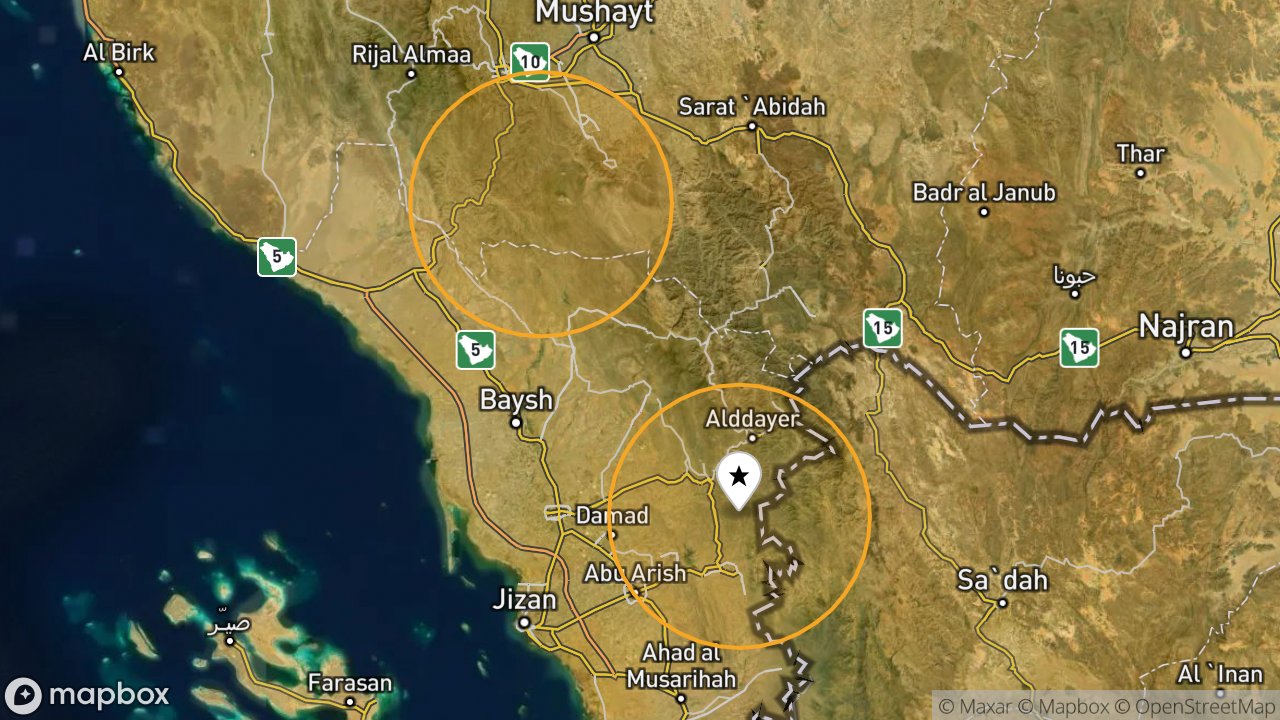 Near Akamat at Tayr, Ta'izz, Yemen (front line, estimat — Houthi forces struck PLC vehicles and positions with Rajoum hexacopter drones carrying Iran-made DIO M48 HE and locally made bombs. At least one Saudi-supplied M60A1/A3 main battle tank was hit.
Sources (14)
This brief is compiled from the day's verified events; each entry links to the event page with media, confidence score and original reporting.
- UK plans to deploy RAF Typhoon fighters, an A400M transport and military advisers to Saudi Arabia to counter e (Deployment, Saudi Arabia (location not reported))
- Turkish Defence Minister Yaşar Güler says Turkish troops will stay in Syria and Iraq until border and regional (Statement, Ankara, Turkey)
- Iranian Parliament Speaker Qalibaf, after meeting Pakistan's army chief, says Iran has nothing new to offer Wa (Statement, Tehran, Iran)
- Mohsen Rezaei, Secretary of Iran's Supreme National Security Council, states that not a single particle of enr (Statement, Tehran, Iran)
- US sending USS Theodore Roosevelt carrier strike group and 13th MEU (~10,000 personnel) to the Middle East by (Aircraft Carrier, North Arabian Sea)
- Eastern Libya's House of Representatives ratified the 2019 Turkey maritime delimitation memorandum with the GN (Diplomacy, Tripoli, Libya)
- The Mecca Joint Defence Agreement among Türkiye, Saudi Arabia and Pakistan has been submitted to the Turkish P (Diplomacy, Grand National Assembly of Turkey, Ankar)
- Saudi military says it intercepted a Houthi ballistic missile aimed at Riyadh; air raid alerts sounded in the (Air Defense, Riyadh, Saudi Arabia)
- IRGC claims two oil tankers were set on fire and disabled after striking naval mines it planted in the souther (Explosion, Southern Strait of Hormuz, Persian Gulf)
- Netanyahu vows to complete elimination of the Iranian regime after discussing it with Trump, and says Hezbolla (Statement, Jerusalem, Israel)
- Iran's FM spokesman Baghaei rejects possible Egyptian military support for Saudi Arabia, warning further inter (Statement, Tehran, Iran)
- US Ambassador Tom Barrack says Israel will not seriously fight Türkiye and warns that an unintended accident, (Statement, Ankara, Turkey)
- Netanyahu, asked about possible preemptive strikes and war with Türkiye, replies 'No, no', rejecting the scena (Statement, Jerusalem, Israel)
- US Ambassador Tom Barrack calls Iran 'not an evil regime' but says the IRGC 'has become an adversary' and its (Statement, Ankara, Turkey)