Russian Geran-3 drone tracked toward Rivne Oblast in multi-wave attack
What happened
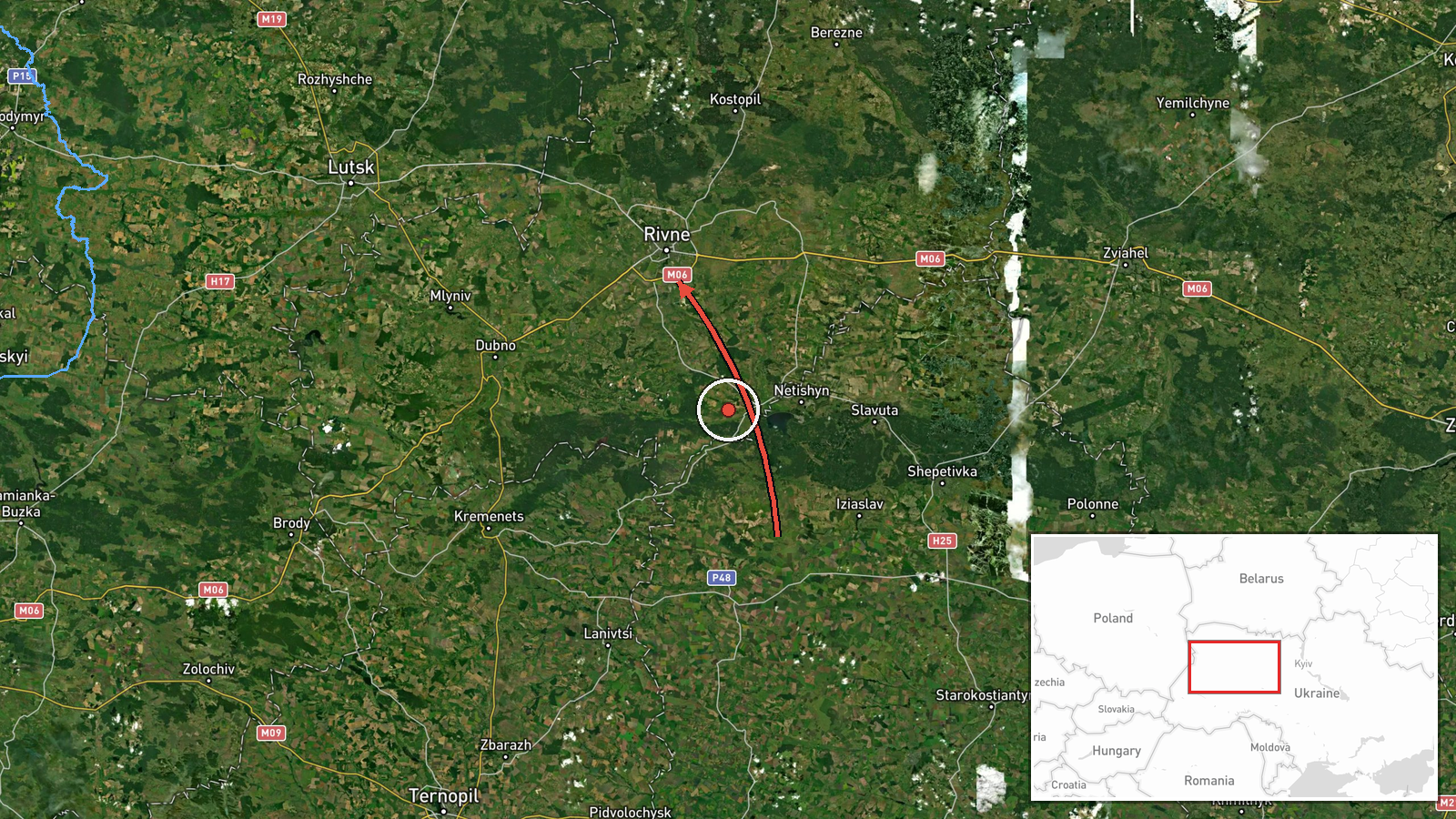
Ukrainian air monitoring reported a single Russian jet-powered Shahed (Geran-3) drone transiting from Khmelnytskyi Oblast toward Rivne Oblast on 13 October at 18:45 UTC, reportedly on a course toward Dubno. The sighting was logged by the Ukrainian Air Force via official Telegram channels. This drone formed part of a broader Russian drone operation across northwestern Ukraine, with multiple Geran-3 aircraft tracked heading toward the same region within a two-hour window.
Context and assessment
Rivne Oblast, situated in northwestern Ukraine near the Belarusian border, has been a recurring target for Russian long-range drone strikes throughout the conflict. The Geran-3 (an Iranian-origin Shahed variant with jet propulsion) represents Russia's sustained air campaign against civilian and military infrastructure at distance. The clustering of at least four separate drone transits toward Rivne and adjacent areas—including toward the city of Dubno and the town of Kostopil—within ninety minutes suggests a coordinated multi-vector attack rather than isolated incidents. Such patterns typically indicate targeting of logistical nodes, energy infrastructure, or military facilities in the region.
Sources and confidence
Report sourced exclusively from @kpszsu (Ukrainian Air Force official Telegram), a reliable real-time air monitoring channel. Single-source reporting and regional-level geolocation precision lower confidence. Cross-confirmation would be provided by independent Ukrainian air defense acknowledgment or visual evidence of interception or impact. Confidence score of 8.0 reflects the source's official status and consistency with contemporaneous related events.
Location
Rivne Oblast, northwestern Ukraine. The drone's reported course toward Dubno, a city in central Rivne Oblast approximately 50 kilometers from the Belarusian border, provides geographic context. The region lies along a known corridor for Russian drone ingress from Belarusian airspace. Precision limited to regional level due to monitoring methodology.
Related events nearby
- Ukrainian air monitoring: 2+ Russian jet-powered Shahed (Geran-3) drones heading toward Rivne Oblast.2026-10-13 18:03 UTC · Drone Transit · Rivne Oblast, Ukraine
- Ukrainian air monitoring reports 1 Russian jet-powered Shahed (Geran-3) drone transiting northern Zhytomyr Obl2026-10-13 17:14 UTC · Drone Transit · Rivne Oblast, Ukraine
- Ukrainian air monitoring: 1 Russian jet-powered Shahed (Geran-3) drone from Rivne Oblast toward Kostopil.2026-10-13 17:25 UTC · Drone Transit · Kostopil, Ukraine
- Ukrainian air monitoring: 1 Russian jet-powered Shahed (Geran-3) drone from Rivne Oblast toward Dubno.2026-10-13 15:49 UTC · Drone Transit · Dubno, Ukraine
- Ukrainian air monitoring: 1 Russian jet-powered Shahed (Geran-3) drone heading toward Lutsk.2026-10-13 18:52 UTC · Drone Transit · Lutsk, Ukraine
▶ View this event on the live map

Intel Mapper aggregates open-source reports from monitored Telegram and X channels, geolocates them, cross-checks duplicates across sources and assigns a confidence score. Entries are updated as new confirmations arrive. Read how we verify events.