Single Russian jet-powered Shahed drone reported transiting northern Zhytomyr Oblast heading west
What happened
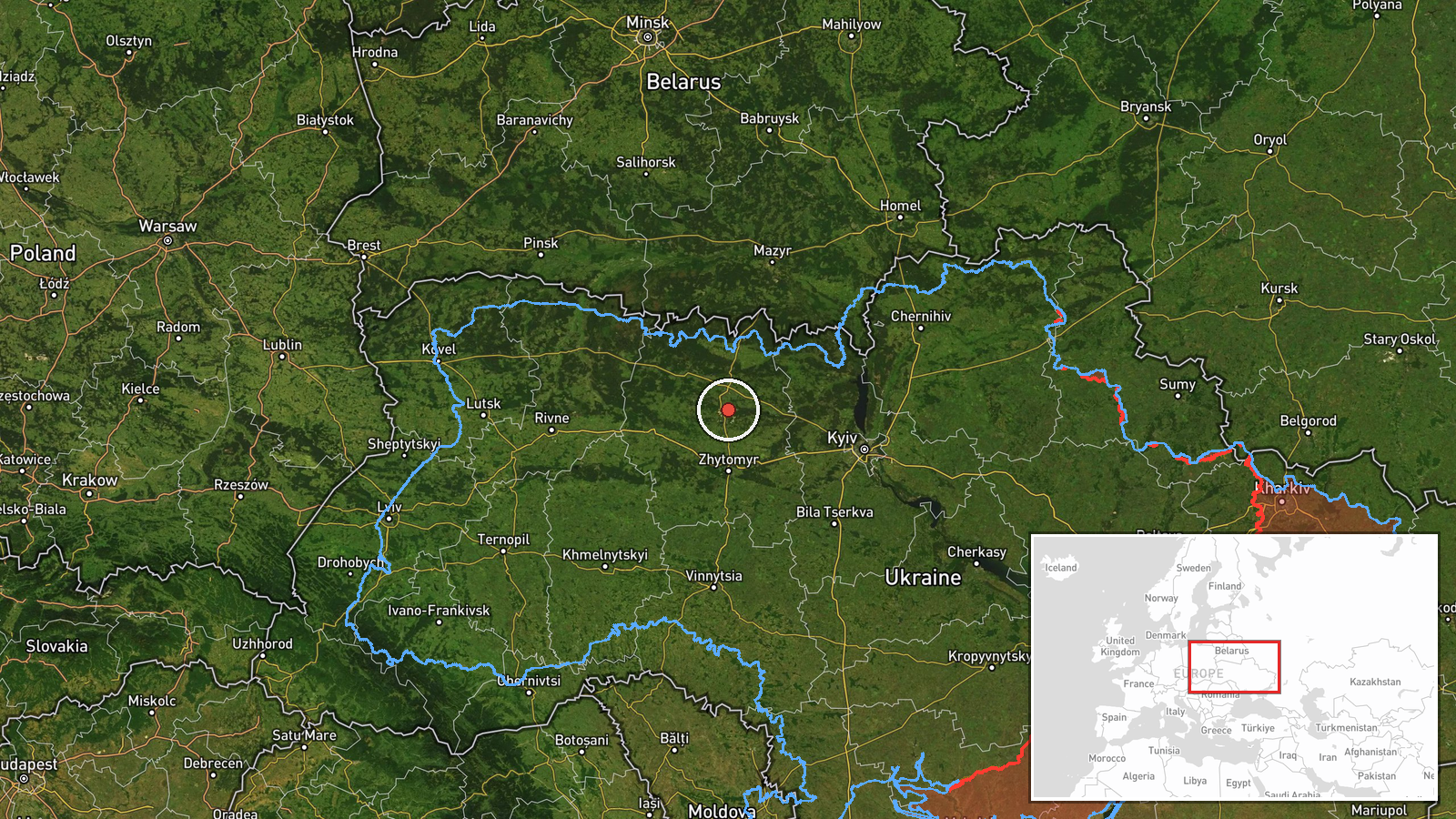
Ukrainian air monitoring reported on Telegram that one Russian jet-powered Shahed, identified as a Geran-3, was passing through northern Zhytomyr Oblast on a westward course at about 12:14 UTC on 21 October 2026. The report, posted by the @kpszsu channel, gives no specific settlement, altitude, speed, or outcome, and it does not say whether the drone was tracked to a target or lost from radar. The original post is in Ukrainian and describes the object as a jet-powered UAV (реактивний БпЛА) moving on a western heading across the north of the oblast. The event is classified as a drone transit rather than a strike, and no impact or casualties are recorded.
Context and assessment
Northern Zhytomyr Oblast lies on the main air corridor that Russian long-range drones have used to approach western and central Ukraine, and the region is close to the Belarusian border, which makes it a frequent route for drones entering from the north or northeast. The related events show a sustained pattern over roughly 36 hours: two or more Geran-3 drones passing the oblast on 20 October, then single drones heading toward or past Ovruch, Korosten, and Cherniakhiv on 21 October, and now another westward transit. The repetition of westward headings across several towns suggests a sequence of drones moving along one or more corridors rather than a set of isolated launches. Operationally, such transits may reflect routing toward targets farther west, decoy or saturation tactics, or drones straying off planned paths. The jet-powered Geran-3 variant is faster and harder to intercept than the older propeller-driven Shahed, so its presence on these routes is worth noting, though the data alone does not establish intent or target.
Sources and confidence
The event rests on one channel, the Telegram account @kpszsu, which relays Ukrainian air monitoring alerts. No second outlet or official confirmation is attached to this entry. The confidence score of 8.0 reflects a credible, specialized military-monitoring source with a consistent track record of such alerts, but it is held below the top of the scale because the report is single-sourced, gives only a region-level location, and lacks independent verification of the track. Confidence would rise with corroboration from a second monitoring or air-command channel, radar or interception data, or a later report naming a specific settlement. It would fall if the alert were retracted, if later reporting placed the drone outside the oblast, or if the track were attributed to a different object.
Location
The location is recorded only at region level, as northern Zhytomyr Oblast, and the coordinates (about 50.80 N, 28.66 E) are an approximate centroid for that area rather than a settlement or facility. The report does not name a town on the track, which is why the location confidence is rated low. The oblast's north is largely forested and marshy Polissia lowland, bordering Belarus, with rivers including the Teteriv and Uzh running through the wider region. Nearby reference points in the related events include Ovruch, Korosten, and Cherniakhiv, which lie on or near the same corridor.
Related events nearby
- Ukrainian air monitoring: 1 Russian jet-powered Shahed (Geran-3) drone passing northern Zhytomyr Oblast, headi2026-10-21 11:13 UTC · Drone Transit · northern Zhytomyr Oblast, Ukraine
- Ukrainian air monitoring: 2+ Russian jet-powered Shahed (Geran-3) drones passing northern Zhytomyr Oblast, hea2026-10-20 13:40 UTC · Drone Transit · northern Zhytomyr Oblast, Ukraine
- Ukrainian air monitoring: 1 Russian jet-powered Shahed (Geran-3) drone heading toward Korosten.2026-10-21 03:28 UTC · Drone Transit · Korosten, Ukraine
- Ukrainian air monitoring: 1 Russian jet-powered Shahed (Geran-3) drone passing Cherniakhiv, heading west.2026-10-21 04:26 UTC · Drone Transit · Cherniakhiv, Ukraine
- Ukrainian air monitoring: 1 Russian jet-powered Shahed (Geran-3) drone heading toward Zhytomyr.2026-10-21 07:55 UTC · Drone Transit · Zhytomyr, Ukraine
▶ View this event on the live map

Intel Mapper aggregates open-source reports from monitored Telegram and X channels, geolocates them, cross-checks duplicates across sources and assigns a confidence score. Entries are updated as new confirmations arrive. Read how we verify events.