Yemen and Iran incidents add to regional strain
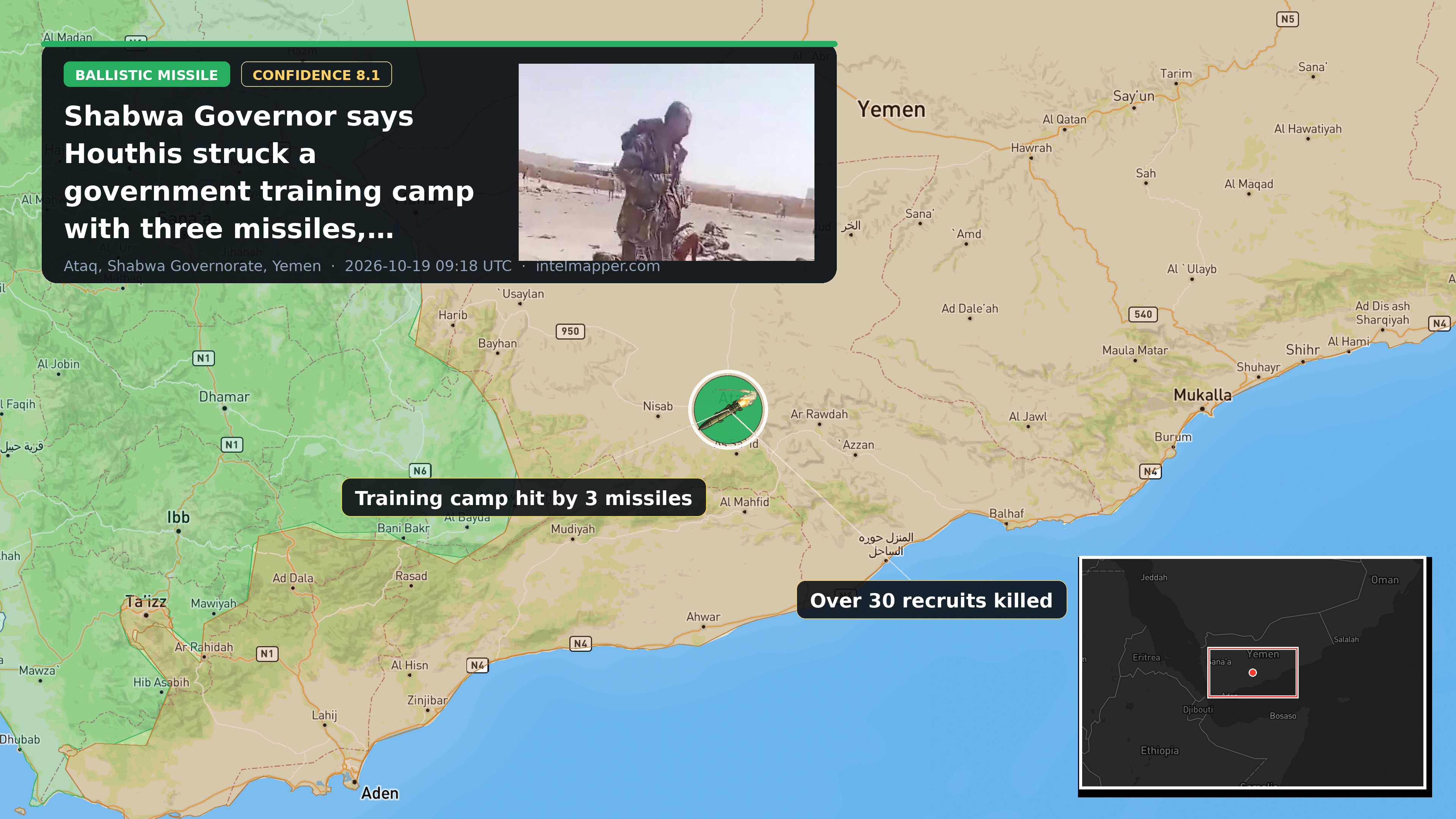
- Houthi missiles struck government training camp in Ataq, Shabwa.
- Saudi-led coalition reportedly intercepted Houthi weapons shipment on Red Sea coast.
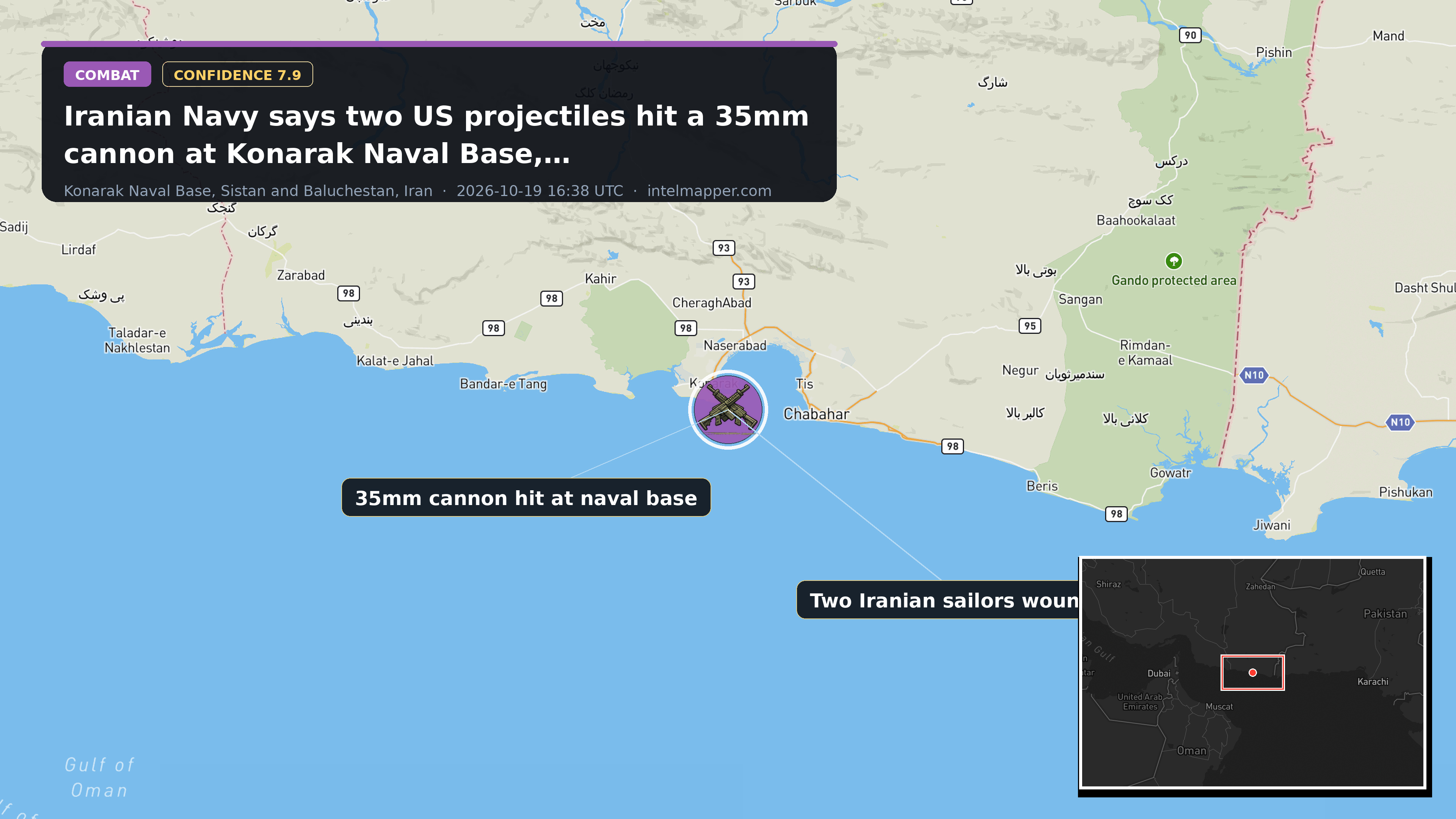
- Iranian Navy claims US projectiles hit Konarak cannon; CENTCOM unconfirmed.
- Netanyahu reportedly ordered Mossad, Aman and IDF to overthrow Iran's regime.
- Egypt's parliament delays Saudi deployment vote until October 26.
What to watch: Over the next 24 to 48 hours, attention should focus on whether the Iranian Navy's claim about Konarak draws a formal CENTCOM statement or an IRGC response, and whether the Urmia launch is confirmed as a test or an…
Full analysis (655 words)
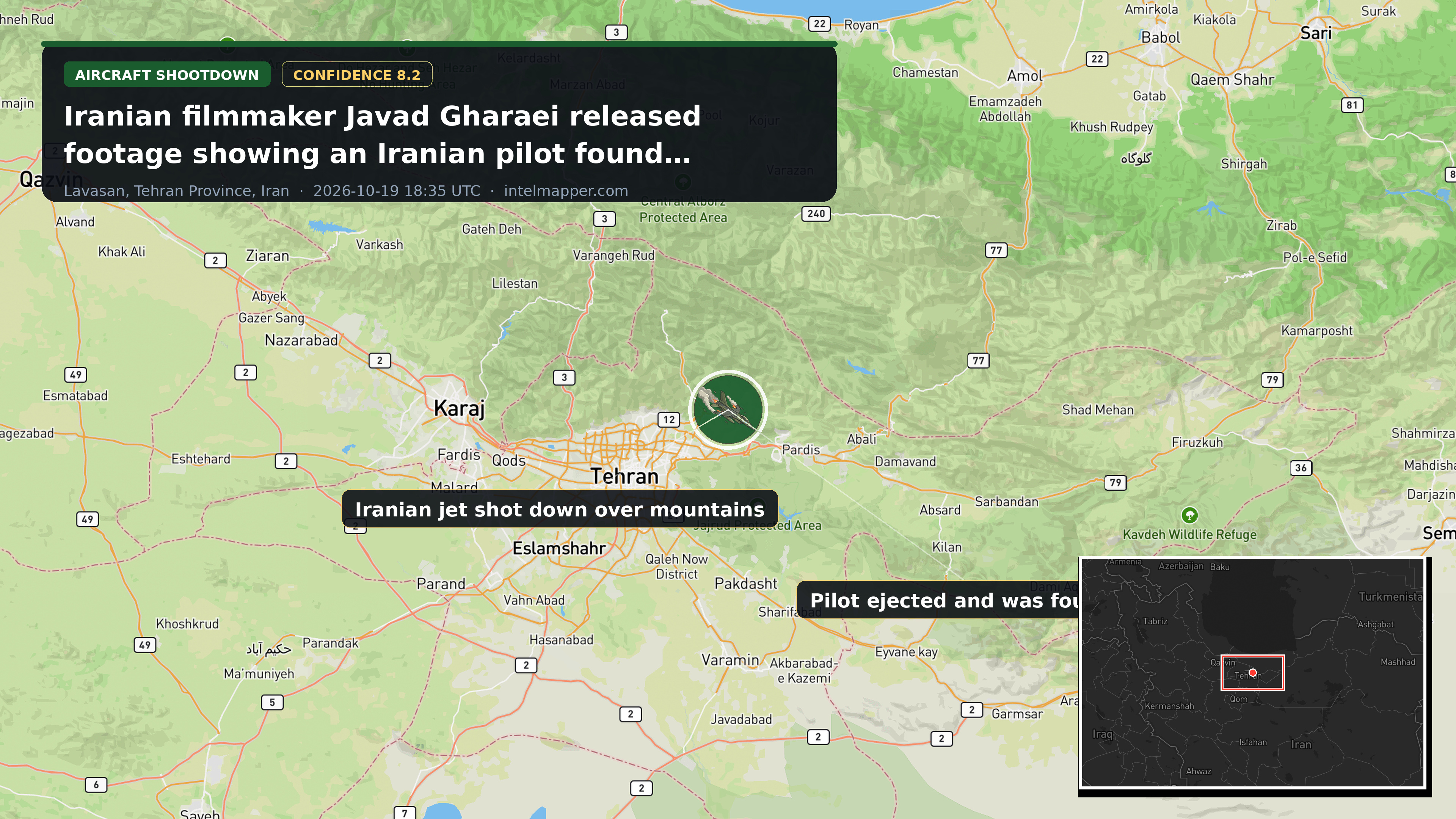
Reporting on 19 October centred on Yemen, Iran and the Gulf. The Shabwa Governor said Houthi missiles struck a government training camp at Ataq, causing heavy casualties among new recruits; he described the attack as a war crime, and the toll is not independently confirmed. Separately, the Saudi-led coalition reportedly intercepted a Houthi weapons shipment as it reached the Red Sea coast and warned vessel owners against facilitating smuggling. On the Iranian side, the Iranian Navy said two US projectiles hit a 35mm cannon at Konarak Naval Base, wounding two personnel. CENTCOM has not confirmed the claim. An IRGC spokesman also issued a veiled threat concerning seven undersea internet cables under the Strait of Hormuz, and a ballistic missile was reportedly launched from Urmia, the third launch that day, with no clear indication it was a test. US diplomatic missions issued security alerts for eleven countries in the region.
Israeli leadership rhetoric was unusually prominent. Netanyahu, speaking at an Air Force base, said Israel would strike enemies when necessary, and he reportedly ordered Mossad, Aman and the IDF to work toward overthrowing Iran's regime, describing a nuclear Iran as a cancer; this is single-sourced. He also told Trump that the two countries share a war objective to be completed together. Finance Minister Smotrich made several statements on Gaza's population, Sinai, the northern border, an Arrow missile sale to Germany and efforts to block US arms deals with Turkey. Statements of this kind are not in themselves operational indicators, but they signal the policy direction of a governing coalition ahead of an election. In Syria, a Damascus source told Kan that officials fear an extraordinary Israeli operation, and an Israeli temporary checkpoint at Al-Alam roundabout in Quneitra led to a detention. Damascus also claims Druze armed groups in al-Sweida are expected to attack government forces with Israeli encouragement; these allegations remain unverified.
Diplomatic activity pointed to a regional realignment in security planning. Egypt's parliament postponed until 26 October a vote on authorising Sisi to send military support to Saudi Arabia; Sisi said any deployment would be defensive and would require a Saudi request. Al-Akhbar, which is Hezbollah-affiliated, reported that Egyptian troops are being prepared for deployment and that Saudi Arabia has resumed funding to Egypt's Central Bank. Macron visited the UAE and inspected troops with President Mohammed bin Zayed. Qatar announced a domestic defence production hub with the United States, the United Kingdom and France, focused on ballistic missiles, drones and cyber threats. The UK Foreign Secretary said Britain would not accept the displacement of Palestinians or the continuing occupation. Taken together, these moves suggest Gulf and Egyptian governments are hedging through partnerships and seeking to shore up their own defences, though the Egyptian deployment question remains unresolved.
Assessment
The day's reporting shows a region under sustained strain, with a high volume of rhetoric and security alerts but relatively few independently confirmed kinetic events. In Ukraine, the Kyiv ballistic strike and the publicly acknowledged early warning fault mark a notable deterioration in air defence conditions and in the US-Ukraine relationship. Many claims, especially from Israeli officials, Iranian sources and Ukrainian General Staff reports, remain unverified and should be weighed accordingly. The most consequential near-term uncertainties are the Iran-related signalling and the Egyptian and Gulf security realignment.
What to watch
Over the next 24 to 48 hours, attention should focus on whether the Iranian Navy's claim about Konarak draws a formal CENTCOM statement or an IRGC response, and whether the Urmia launch is confirmed as a test or an operational event. Israeli statements on Iran and Syria should be watched for any operational follow-through, particularly around the Quneitra checkpoint and al-Sweida, where unverified warnings of Israeli-backed Druze action have been raised. In Ukraine, the scale of the next Russian ballistic wave, any independent confirmation of civilian casualties in Kyiv, and whether Washington responds to Zelensky's Patriot proposal will be key indicators. Egyptian parliamentary developments ahead of 26 October also bear watching.
Sources (14)
This brief is compiled from the day's verified events; each entry links to the event page with media, confidence score and original reporting.
- Netanyahu, visiting an Israeli Air Force base, says Israel is ready to strike enemies when necessary and warns (Statement, Jerusalem, Israel)
- Iranian filmmaker Javad Gharaei released footage showing an Iranian pilot found after his Yak-130 was shot dow (Aircraft Shootdown, Lavasan, Tehran Province, Iran)
- Netanyahu says he told Trump that Israel is the only fighting ally the United States has in the world. (Statement, Jerusalem, Israel)
- Macron visits the UAE and inspects troops with President Mohammed bin Zayed amid regional crisis and unrest at (Diplomacy, Paris, France)
- Qatar announces a new domestic defense production hub with the US, UK and France, aimed at countering ballisti (Diplomacy, Doha, Qatar)
- Shabwa Governor says Houthis struck a government training camp with three missiles, causing heavy casualties a (Ballistic Missile, Ataq, Shabwa Governorate, Yemen)
- Egypt's parliament postponed a vote on authorizing Sisi to send military support to Saudi Arabia until October (Statement, Cairo, Egypt)
- Per Al-Akhbar (Hezbollah-affiliated), Egypt prepares to deploy troops to Saudi territory for defense missions; (Statement, Saudi Arabia (location not reported))
- IRGC spokesman issued a veiled threat that seven undersea internet cables under the Strait of Hormuz are being (Statement, Tehran, Iran)
- Iranian Navy says two US projectiles hit a 35mm cannon at Konarak Naval Base, wounding two Iranian Navy person (Combat, Konarak Naval Base, Sistan and Baluchest)
- Turkish President Erdogan says 'good news comes from Syria' and accuses Israel of trying to stir chaos there. (Statement, Ankara, Turkey)
- Increased arrivals of oil and gas tankers at Baniyas port; open-source analysts reportedly reveal details of t (Cargo Ship, Baniyas Port, Tartus Governorate, Syria)
- Sweida Governor Mustafa al-Bakour warns residents that the crisis must not become a conflict between the gover (Statement, As-Suwayda, Suwayda Governorate, Syria)
- Israeli forces set up a temporary checkpoint at Al-Alam roundabout in Quneitra countryside and detained a youn (Security, Al-Alam Roundabout, Quneitra Countryside)