Kyiv hit by ballistic missile barrage
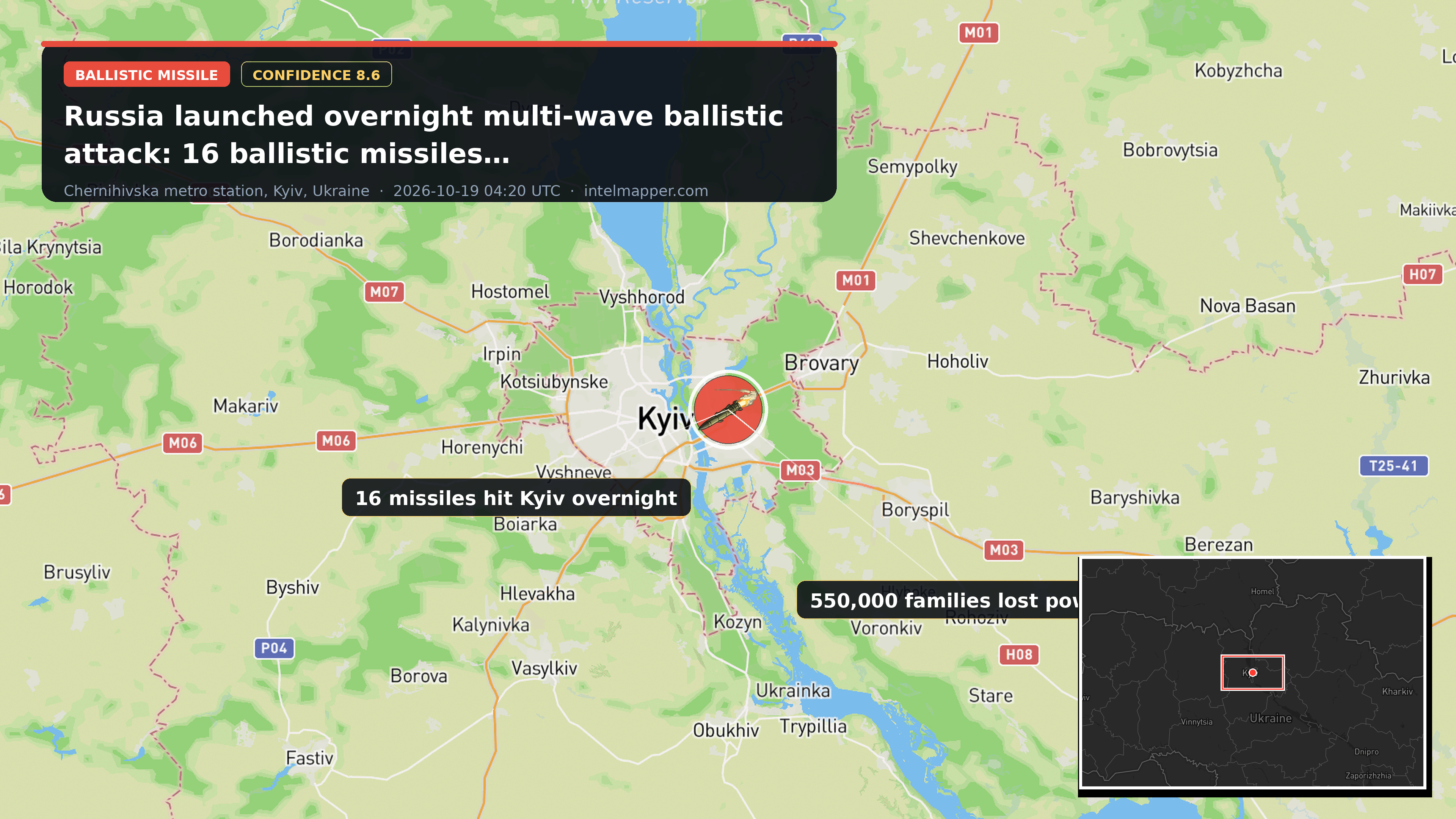
- Russia fired sixteen ballistic missiles at Kyiv and region overnight.
- Rubio says Trump troubled by Kyiv apartment strike killing civilians.
- Zelensky offers pause on diesel strikes for Patriot missiles.
- Ukrainian General Staff reports 16 clashes near Pokrovsk direction.
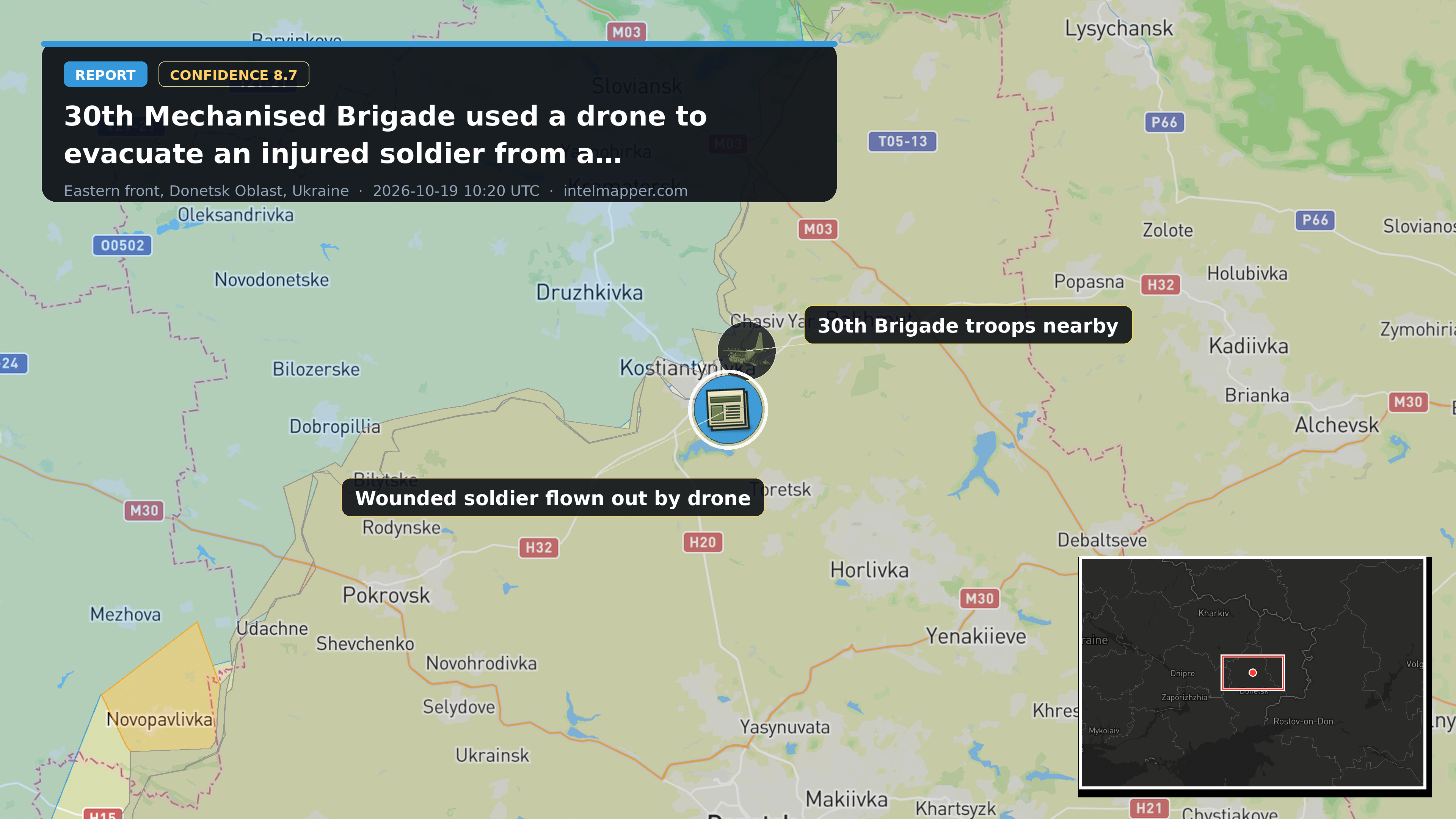
- 30th Brigade reportedly conducted first drone medevac from a battlefield.
What to watch: In Ukraine, the scale of the next Russian ballistic wave, any independent confirmation of civilian casualties in Kyiv, and whether Washington responds to Zelensky's Patriot proposal will be key indicators.
Full analysis (623 words)
The most significant event was an overnight Russian multi-wave attack on Kyiv and Kyiv Oblast, involving sixteen ballistic missiles and more than 200 drones. Reported damage included energy facilities, a clinic, a school, a metro station and residential buildings. Casualty figures in the available reporting are incomplete and should be treated cautiously. US Secretary of State Rubio said President Trump was troubled by a ballistic strike on a Kyiv apartment building that killed civilians and described the difficulty of resolving the war as very frustrating. Rubio also said a software problem had affected Ukraine's early warning system several nights earlier, with EUCOM investigating; he declined to comment on the most recent night's events. Zelensky offered to halt strikes on Russian diesel facilities in exchange for Patriot missiles, and he accused Washington of pressuring Kyiv toward capitulation and restricting battlefield communications. These statements point to visible strain in the air defence relationship.
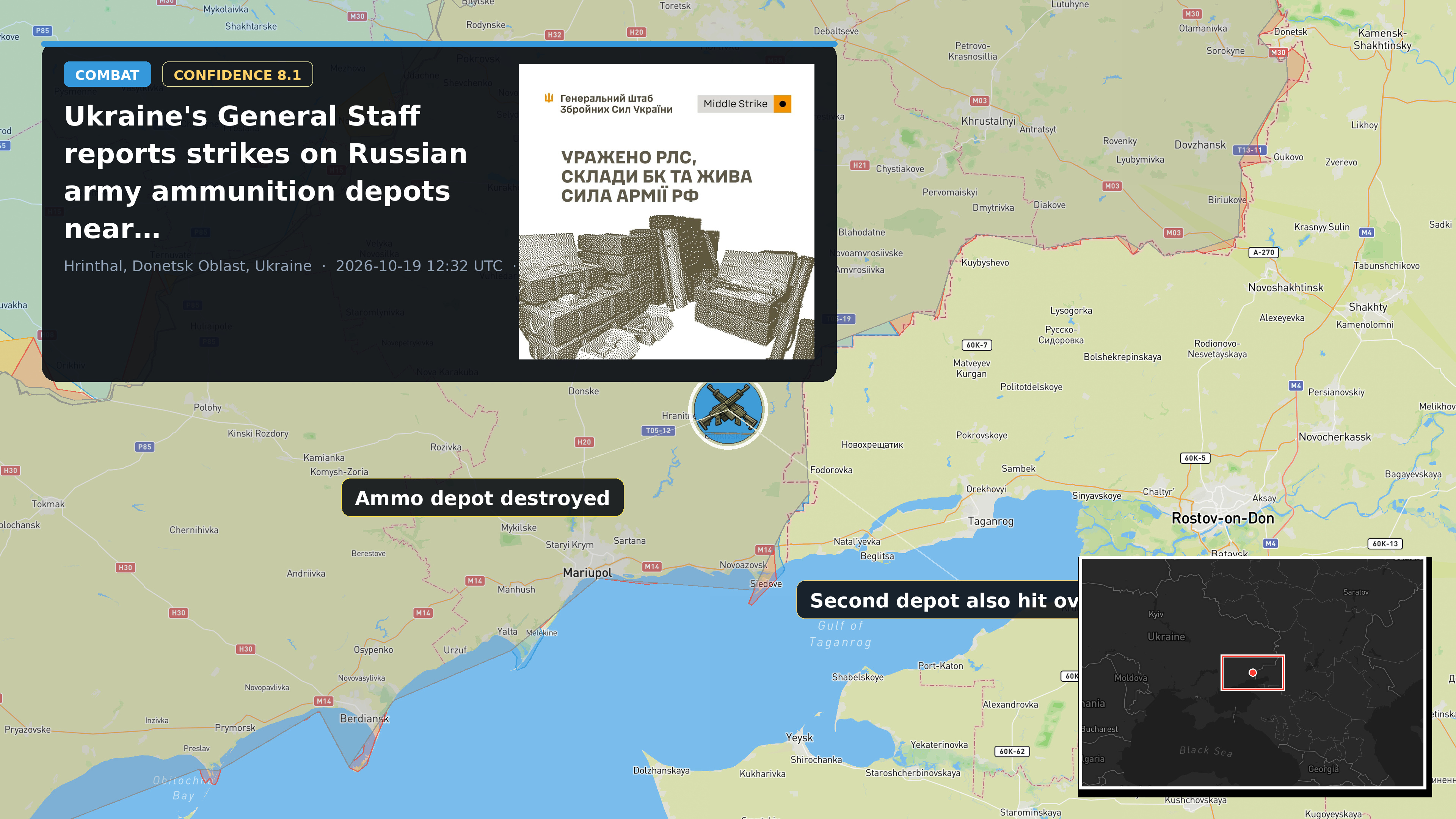
Ground activity was reported at a moderate level. The Ukrainian General Staff recorded sixteen clashes on the Pokrovsk direction across nine settlements, with one still ongoing, and claimed 26 Russian personnel killed and 167 drones destroyed or suppressed. It reported nine attacks in the Huliaipole direction, three repelled attacks on the Sloviansk direction near Yampil and Mykolaivka, and 22 clashes in 24 hours in the South-Slobozhansky direction near Starytsia. The General Staff also reported no significant Russian offensive actions on several other directions. These figures are Ukrainian official claims and cannot be independently verified from this data. A separate report credited the 30th Mechanised Brigade with what is reportedly the first drone medical evacuation of an injured soldier from a battlefield, after mines and enemy drones blocked ground evacuation in Donetsk Oblast. The report is single-sourced but consistent with the wider pattern of drones shaping front-line logistics.
Air monitoring showed a sustained stream of Russian jet-powered Geran-3 and Shahed-type drones moving across western and central Ukraine, with tracks reported over Lviv, Rivne, Zhytomyr, Volyn, Vinnytsia, Kyiv, Kharkiv, Kremenchuk and Odesa. Further strategic developments included a report that the Russian military satellite Cosmos 2612 manoeuvred close to a commercial satellite supporting Ukraine's military before abruptly changing course, which analysts interpret as intimidation in orbit. A Frankfurter Allgemeine report said Russia is building a large radar in Kaliningrad designed to monitor most aircraft and missiles across Europe. In Germany, Chancellor Merz pledged more than €500 billion by the end of the decade to strengthen defence capacity and military infrastructure, citing the Russian threat. These developments reflect a longer-term European rearmament trajectory alongside the immediate air campaign.
Assessment
The day's reporting shows a region under sustained strain, with a high volume of rhetoric and security alerts but relatively few independently confirmed kinetic events. In Ukraine, the Kyiv ballistic strike and the publicly acknowledged early warning fault mark a notable deterioration in air defence conditions and in the US-Ukraine relationship. Many claims, especially from Israeli officials, Iranian sources and Ukrainian General Staff reports, remain unverified and should be weighed accordingly. The most consequential near-term uncertainties are the Iran-related signalling and the Egyptian and Gulf security realignment.
What to watch
Over the next 24 to 48 hours, attention should focus on whether the Iranian Navy's claim about Konarak draws a formal CENTCOM statement or an IRGC response, and whether the Urmia launch is confirmed as a test or an operational event. Israeli statements on Iran and Syria should be watched for any operational follow-through, particularly around the Quneitra checkpoint and al-Sweida, where unverified warnings of Israeli-backed Druze action have been raised. In Ukraine, the scale of the next Russian ballistic wave, any independent confirmation of civilian casualties in Kyiv, and whether Washington responds to Zelensky's Patriot proposal will be key indicators. Egyptian parliamentary developments ahead of 26 October also bear watching.
Sources (14)
This brief is compiled from the day's verified events; each entry links to the event page with media, confidence score and original reporting.
- 30th Mechanised Brigade used a drone to evacuate an injured soldier from a minefield, reportedly the first dro (Report, Eastern front, Donetsk Oblast, Ukraine)
- Russia launched overnight multi-wave ballistic attack: 16 ballistic missiles targeting Kyiv and Kyiv Oblast, p (Ballistic Missile, Chernihivska metro station, Kyiv, Ukrain)
- Rubio says a software problem affected Ukraine's early warning system a few nights ago. EUCOM is investigating (Statement, Washington, D.C., USA)
- Ukrainian air defense downed 418 of 463 Russian strike drones (Shahed, Parodiya, Gerbera, Banderol, Italmas) o (Air Defense, Ukraine (location not reported))
- Ukraine's General Staff reports strikes on Russian army ammunition depots near Hrinthal and Ternove, Donetsk O (Combat, Hrinthal, Donetsk Oblast, Ukraine)
- Overnight Russian attack: Iskander-M/S-400 ballistic and Iskander-K cruise missiles plus 269 Shahed-type drone (Ballistic Missile, Ukraine)
- Ukrainian General Staff publishes cumulative Russian combat loss tally covering 24.02.22 to 19.10.26. (Report, Kyiv, Ukraine)
- Zelensky offers to halt strikes on Russian diesel facilities in exchange for Patriot missiles, and accuses Was (Statement, Kyiv, Ukraine)
- Ukrainian air monitoring: 1 Russian jet-powered Shahed (Geran-3) drone heading toward Lviv. (Drone Transit, Lviv, Ukraine)
- Ukrainian air monitoring: 1 Russian jet-powered Shahed (Geran-3) drone heading toward Rivne Oblast. (Drone Transit, Rivne Oblast, Ukraine)
- Ukrainian air monitoring: 1 Russian Shahed-type drone passing Black Sea, heading north. (Drone Transit, Black Sea, Ukraine)
- Ukrainian air monitoring: 1 Russian jet-powered Shahed (Geran-3) drone heading toward Bila Tserkva. (Drone Transit, Bila Tserkva, Ukraine)
- Ukrainian air monitoring: 1 Russian jet-powered Shahed (Geran-3) drone from northern Zhytomyr Oblast toward no (Drone Transit, northern Rivne Oblast, Ukraine)
- Ukrainian air monitoring: 1 Russian jet-powered Shahed (Geran-3) drone over Lviv Oblast. (Drone Transit, Lviv Oblast, Ukraine)