Moscow-area strikes and Russian missile attacks on Kyiv; reported Iran operation planning
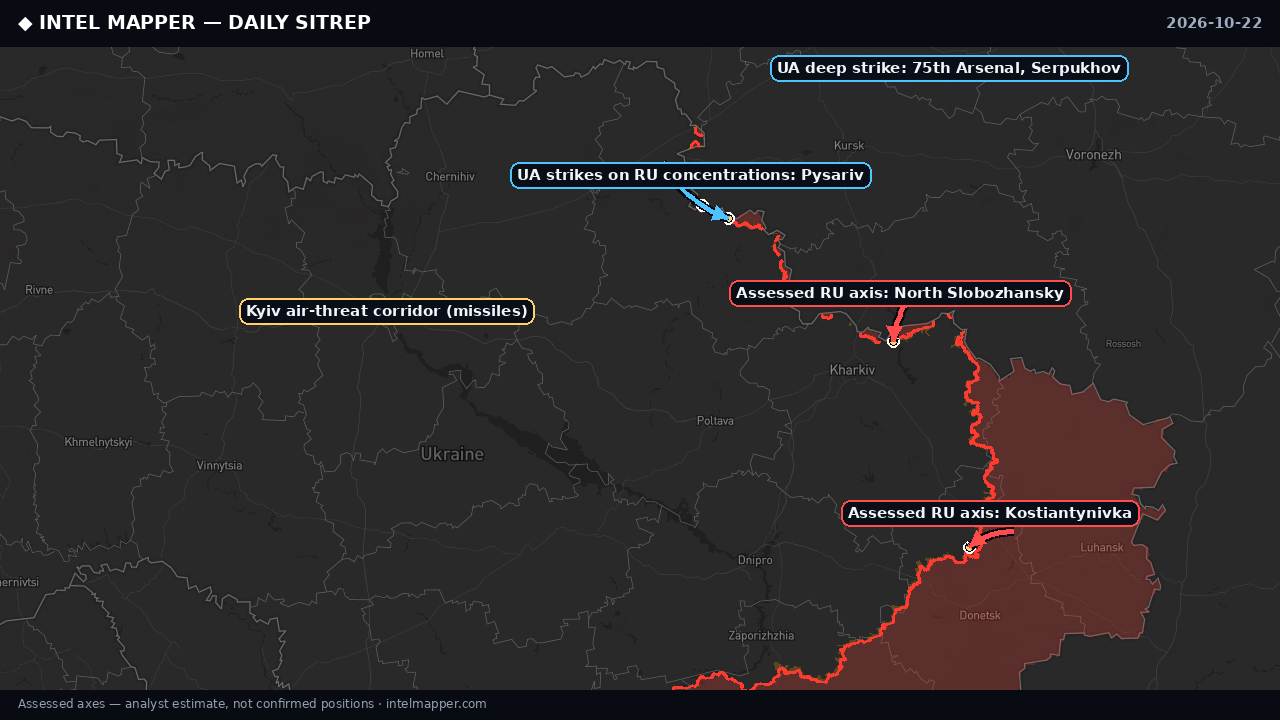
Key developments
- Ukraine reportedly launched over 600 drones toward areas near the Russian Ministry of Defence in Moscow.
- Ukraine reportedly struck the 75th Arsenal in Serpukhov, a facility repairing Buk and S-300V air defence systems.
- Russia fired fresh overnight missile attacks on Kyiv, injuring six people and damaging homes and a petrol station.
- Ukrainian air monitoring logged multiple Russian ballistic missiles over Kyiv and 25 Zircon or Oniks missiles over Peredmistia.
- Syrian security forces conducted an operation against an Islamic State cell in Rankous, Rif Dimashq.
- A single-source Israeli report says the US and Israel have prepared a severe operation against Iran after the elections.
- A young man with disabilities was reportedly killed by Israeli gunfire in Jamla, western Daraa.
Middle East 3 tracked events
The tracked Middle East events for 22 October 2026 are few in number and rest on single sources. In Syria, the Internal Security Forces, working with General Intelligence, conducted an operation against an Islamic State cell in Rankous, in the Rif Dimashq governorate. The report gives no casualty figures, arrest totals or size of the cell, so the outcome cannot be assessed beyond the fact of the operation. Separately, a young man with disabilities was reportedly killed by Israeli gunfire in Jamla village, in the western Daraa countryside. The source classifies the incident as combat but does not specify whether it occurred during a raid or near the frontier. Both reports come from a single Telegram channel and had not been independently corroborated at the time of compilation.
Taken together, the two Syrian items reflect a layered security environment in the south and centre of the country. Damascus-led security structures are conducting counter-Islamic State operations in areas where residual cells have persisted since the group lost its territorial base. The southwest, near Daraa, remains a zone of recurring friction involving Israeli forces, which have maintained a presence in parts of the buffer zone along the Golan since late 2024. Civilian casualties from such incidents are usually reported first through local channels, which accounts for the single-source status of the Jamla report. Verification gaps of this kind are routine in this theatre, and attribution of intent should be treated cautiously until additional sourcing emerges.
The most consequential item is an Israel Hayom report, which reportedly states that the United States and Israel have prepared a severe military operation against Iran, to be launched after the forthcoming Israeli elections. This is a single-source claim, and no official confirmation appears in the tracked data. Its significance lies less in operational detail than in the implied timeline: a campaign deferred until after an electoral period would reflect domestic political considerations as much as military readiness. Any such operation would carry wide regional implications, including for Gulf shipping, Iraqi and Lebanese partner networks and the Syrian corridor. Analysts should treat the report as a warning indicator rather than a confirmed plan.
- Syrian Internal Security Forces, with General Intelligence, conducted an operation against an ISIS cell in Ran
- Israel Hayom reports the US and Israel prepared a severe military operation against Iran to be launched after
- A young man with disabilities was killed by Israeli occupation gunfire in Jamla village, western Daraa country
Ukraine 18 tracked events
Ukrainian sources report that more than 600 drones were launched at areas near the Russian Ministry of Defence on the Frunzenskaya Embankment in Moscow, an event recorded as a drone shootdown. Separately, Ukrainian strikes reportedly hit plants producing armoured vehicles for the Russian army and facilities maintaining air defence systems. Ukraine also reportedly struck the 75th Arsenal in Serpukhov, Moscow Oblast, a facility repairing Buk-M1, Buk-M2 and S-300V systems, using missiles and or jet drones; damage assessment is ongoing. An unconfirmed Telegram report describes an Oreshnik missile overflying a logistics centre at Domodedovo with no impact confirmed, and a further unconfirmed report describes alarm near Domodedovo airport. On the Russian side, overnight missile attacks on Kyiv injured six people and damaged homes and a petrol station.
Ukrainian General Staff reporting describes continued Russian activity across several axes. Russian forces reportedly conducted two aviation strikes using six guided aerial bombs and 47 shellings in the North Slobozhansky and Kursk directions over the past day. Settlements in Sumy Oblast were shelled overnight, along with Khrinivka in Chernihiv Oblast, with casualty details not specified. The General Staff reports two Russian attacks near Ozerne and toward Mykolaivka in the Sloviansk direction, none in the Kramatorsk direction, and seven around Kostiantynivka and toward Novopavlivka. Ukrainian aviation, missile troops and artillery reportedly struck Russian concentrations near Pysarivka, Kyianytsia, Pustohorod and Novokostiantynivka. The General Staff also claims 2,250 Russian personnel losses in the past day, together with equipment losses; these figures are attributed to Ukraine and cannot be independently verified from the tracked data.
Ukrainian air monitoring logged a substantial missile profile overnight. Several Russian ballistic missiles were reported over Kyiv, and Zircon or Oniks cruise missiles were tracked passing Nizhyn toward the capital, including a group of 25 reported over Peredmistia. A ballistic missile was also reported over Bryansk, Russia. The attacks occurred even as Moscow signalled readiness for trilateral talks with the United States, a pattern in which diplomatic signalling has coexisted with sustained long-range strikes. The General Staff published a cumulative figure for Russian combat losses from 24 February 2022 to 22 October 2026, but the post itself contained no figures, so no independent tally can be drawn from it.
- Ukraine launched over 600 drones at areas near the Russian Ministry of Defence in Moscow. Separately, it struc
- Russian forces conducted two aviation strikes using six guided aerial bombs (KAB) and 47 shellings of Ukrainia
- Ukrainian aviation, missile troops and artillery struck Russian personnel and equipment concentrations in thre
- Russian forces shelled multiple Sumy Oblast settlements overnight, plus Khrinivka in Chernihiv Oblast; casualt
- Ukrainian General Staff reports two Russian attacks near Ozerne and toward Mykolaivka (Sloviansk direction), n
- Ukrainian General Staff reports 2,250 Russian personnel losses in the past day, plus 3 tanks, 8 armored vehicl
What to watch
Over the next 24 to 48 hours, attention should centre on whether Israeli officials confirm or deny the reported plan for a severe operation against Iran, and whether regional partners or the United States comment publicly. In Ukraine, damage assessments from the Serpukhov and Moscow-area strikes may clarify whether the reported facilities were hit as claimed, and any Russian retaliation against Kyiv or energy infrastructure would be a further indicator of escalation. Watch also whether the signalled trilateral talks with Washington are formally scheduled, since continued missile salvos alongside diplomatic outreach would suggest parallel bargaining rather than a pause. Independent confirmation of casualty figures in Sumy, Kharkiv and Donetsk remains limited, and early reports should be treated as provisional.