Hebron attack prompts West Bank lockdown; Russian drone waves continue across Ukraine
Key developments
- Two Palestinian gunmen were killed after a shooting attack wounded Israeli soldiers at a Hebron-area checkpoint.
- Israel has locked down Hebron and signalled expanded West Bank operations, with reported calls for full control.
- Iranian officials threatened Gulf-wide retaliation and renewed threats against Israel's Dimona facility.
- Turkey advanced naval cooperation with Syria and signed a $442.5 million ASELSAN export contract.
- Russia sustained a large wave of Shahed, ballistic, cruise, and glide-bomb activity across Ukrainian oblasts.
- A drone strike reportedly sank the cargo ship KHORYV off Constanța, Romania, with casualties.
- Estonia is deploying instructors to Operation LEGIO, while France and Britain held a first joint nuclear exercise.
Middle East 30 tracked events
On 23 October, two Palestinian gunmen reportedly opened fire at an Israeli Defense Forces checkpoint at Yehuda (Judea) Junction near Hebron, firing hundreds of rounds and wounding Israeli soldiers. Reported casualty figures differ across sources, with one account citing six soldiers wounded, two critically, and another citing five Israelis wounded. Both attackers were killed. IDF Chief of Staff Eyal Zamir said rapid action by soldiers prevented a larger attack, and a large ammunition cache was reportedly found in the attackers' vehicle. Israeli assessments describe a planned mass-casualty attack against travelers on Route 35. Hebron was cordoned off, and Prime Minister Netanyahu reportedly ordered expanded measures. He said forces would enter neighbourhoods, evacuate residents, and search house to house to destroy what he termed terrorist infrastructure. Minister Ben Gvir called for full Israeli control of the West Bank.
The day also featured a cluster of deterrence signalling between Iran, Israel, and the Gulf states. Iranian officials warned that renewed US or Israeli airstrikes would trigger retaliation across the Gulf, potentially targeting US bases, warships, airports, and oil pipelines. Iran-linked media again threatened Israel's Dimona nuclear facility, and a source claimed the main site is buried too deeply for Iranian missiles to reach. IRGC Navy commander Ali Azmaei stated that US forces had moved 600 to 700 km away from the Strait of Hormuz, while Foreign Minister Araghchi made claims about US missile defence expenditure and interceptor use. Newly released footage reportedly shows an Iranian missile striking a US base in the UAE a few metres from American personnel. Separately, a reported US Tomahawk strike on a school in Minab on 28 February, which reportedly killed about 156 people, was raised again and is unverified. Satellite imagery indicates Saudi Arabia is expanding its al-Duwadimi ballistic missile complex, and a US E-3G AWACS is returning to Prince Sultan Air Base.
Several developments point to continuing regional militarisation and realignment. Turkish naval representatives visited Latakia, Syria, and reportedly agreed a memorandum of understanding and a cooperation roadmap on ship maintenance and modernisation. In Ankara, Turkish defence firm ASELSAN signed a $442.5 million export contract with an unnamed international customer. The Turkish General Staff also created the International Joint Strategic Command to direct overseas forces. Egypt called for renewed diplomacy on Yemen as its parliament prepares a 26 October vote on military support for Saudi Arabia against the Houthis. Airstrikes hit Houthi-held positions in Taiz, though the attacker was not identified. Israeli forces advanced into Zarzoura farm in Syria's Quneitra countryside, prompting demonstrations in several Syrian governorates. An IDF airstrike was reported in southern Lebanon near Kafr Tibnit. Taken together, the day suggests a widening West Bank security campaign and a sustained Iranian deterrence posture, with Gulf basing and regional arms-industrial activity continuing in parallel.
- Two Palestinian gunmen fired hundreds of rounds in a mass-casualty attack in Hebron, seriously wounding Israel
- Netanyahu says IDF will enter neighborhoods, evacuate residents, search house to house and destroy 'terrorist
- Turkish naval delegation, including ASFAT representatives, visited Latakia to assess Syrian Navy capacity. The
- Israeli forces killed two Palestinian gunmen near Hebron after a shooting attack wounded six Israeli soldiers,
- Two Hebron gunmen fired on an IDF checkpoint at Judea Junction; 5 Israelis wounded, both attackers killed. IDF
- Iran warns renewed US and Israeli airstrikes would trigger retaliation across the Gulf, targeting US bases, wa
Ukraine 30 tracked events
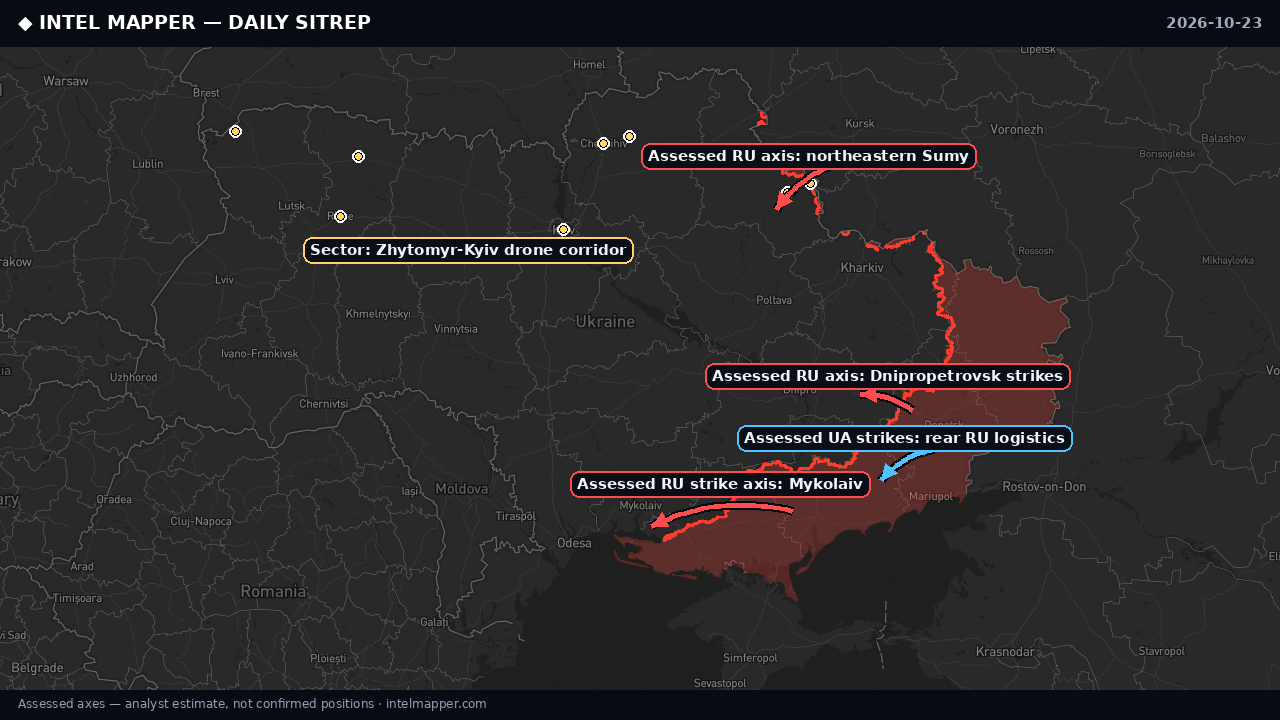
Russian long-range drone activity dominated the Ukrainian air picture on 23 October. Ukrainian air monitoring logged a large number of jet-powered Geran-3 Shahed-type drones moving through Zhytomyr, Vinnytsia, Kyiv, Cherkasy, Chernihiv, Poltava, Odesa, Dnipropetrovsk, Kharkiv, and Mykolaiv oblasts, with some groups travelling from Belarus toward Kyiv Oblast and others from the Black Sea. Alerts also reported a Banderol mini cruise missile heading toward Chernihiv and a ballistic missile heading toward Bilhorod-Dnistrovskyi. Guided glide bombs (KAB) were tracked toward northeastern Sumy and Dnipropetrovsk oblasts. These are air-alert reports rather than confirmed impact assessments, and most do not specify damage. A Telegram photo report documented a night strike on the Marshal plant in Russian-held Luhansk, but the weapon type and damage were not specified. Imagery also showed Ukrainian Mi-8 helicopters carrying up to 12 F7 Litavr interceptor drones on external racks, a sign of continued adaptation to the Shahed threat.
The most significant maritime development was the sinking of the cargo ship KHORYV (IMO 8138712) after a drone strike in the Black Sea about 13 nautical miles off Constanța, Romania. The reported casualties were one crew member dead, three missing, and nine injured. The incident places commercial shipping near the Romanian coast, a NATO member state, within the reach of the wider conflict and raises concern about maritime safety and insurance in the western Black Sea. Responsibility was not stated in the summary provided, and the account of the strike should be treated as a single-source report pending confirmation by maritime authorities. Strike and air-alert patterns in the south and west suggest continued pressure on Odesa and Mykolaiv oblasts, and on Black Sea logistics, even as Ukrainian air defences publicly track and respond to each wave.
On the diplomatic and force-generation side, Estonia is deploying up to 20 instructors to Operation LEGIO, which trains Ukrainian Armed Forces personnel in Poland, with the Nordic-Baltic Eight, Poland, Australia, and New Zealand also participating. Russian President Vladimir Putin stated that Russia is not preparing for war with Europe, amid continuing tensions over the Ukraine conflict; the statement was not accompanied by any verifiable change in posture. Separately, French and British air forces conducted their first joint nuclear exercise, with RAF Typhoons participating in a French nuclear deterrence drill. The timing of that exercise, alongside Russian rhetoric and continued long-range strikes, is likely to be read in Moscow as a signal of European coordination. Taken as a whole, the Ukrainian theatre on this date combined sustained aerial attrition, a maritime incident on NATO's flank, and continued Western training and deterrence activity.
- Imagery shows Ukrainian Mi-8 helicopters carrying up to 12 F7 Litavr interceptor drones on external racks, des
- Telegram photo report documents a night strike on the Marshal plant in Russian-held Luhansk. Weapon type and d
- Putin says Russia is not preparing for any war with Europe, amid ongoing tensions over the Ukraine conflict.
- Estonia deploys up to 20 instructors to Operation LEGIO training Ukrainian Armed Forces in Poland, with NB8, P
- Ukrainian air monitoring: 1 Russian jet-powered Shahed (Geran-3) drone heading toward Zhytomyr.
- Ukrainian air monitoring: 1 Russian Shahed-type drone passing Sumy Oblast, heading west.
What to watch
In the next 24 to 48 hours, attention should focus on the scale and timing of Israeli operations in Hebron and wider West Bank, including evacuations, cordons, and any escalation in casualties on either side. Iranian and Gulf rhetoric on retaliation may shift if any new strikes occur, particularly around US installations in the UAE and Saudi Arabia. Egypt's parliamentary vote on 26 October regarding support for Saudi Arabia against the Houthis is a scheduled point of potential change. Russian overnight drone and missile waves are likely to continue, and maritime advisories in the western Black Sea near Constanța merit monitoring following the KHORYV incident. Verification of single-source claims, including the Luhansk strike and the Minab allegations, remains pending.