WSJ reports Musk ordered Starlink speeds throttled in Ukraine, affecting military communications
What happened
A single post on X, attributed to the account @ConflictTR, relays a Wall Street Journal report that Elon Musk, head of SpaceX, ordered the speeds of Starlink satellite internet service in Ukraine to be throttled. The post states that the reduction affects Ukrainian military communications. The original text is written in Turkish; its headline says Musk gave the order to slow Starlink's speed in Ukraine, followed by a link to the WSJ. The event is logged for 20 October 2026 at 23:34 UTC. It is geolocated to Ukraine as a whole rather than to a specific settlement. The available material does not say when the throttling began, which units were affected, or whether an official response followed. The claim rests on the relayed headline rather than on the full article text.
Context and assessment
Starlink has become a significant part of Ukraine's communications since Russia's full-scale invasion, and it is widely reported to support frontline command links, drone operations, and civilian connectivity when terrestrial networks are damaged. Any reported change to service speeds therefore carries operational weight, whether the throttling targets specific users, specific terminals, or the network as a whole. The report sits against a heavy backdrop of Russian air activity recorded the same day. Ukrainian air monitoring logged an overnight attack involving 165 Shahed-type, Gerbera and decoy drones, with 115 shot down or suppressed and impacts reported at 30 locations. The General Staff's 24-hour summary described one missile strike, 63 airstrikes, 217 guided glide bombs and thousands of kamikaze drones and shellings. Later drone-transit alerts placed jet-powered Geran-3 drones moving through Cherkasy Oblast and toward Pereiaslav. The data does not link those transit reports to the Starlink item, and nothing here indicates the throttling was a response to Russian electronic or kinetic action. Operationally, a reduction in satellite bandwidth during intense drone activity would matter most if it constrained links used for reconnaissance feeds or coordination, but that inference depends on details the report does not supply.
Sources and confidence
The item rests on one reporting channel, an X account relaying a Wall Street Journal report. The post carries a Turkish headline and link but no independent corroboration, and no second outlet covering the same claim appears in the related records. The confidence score of 6.1 reflects that single-source status, the lack of direct quotes from SpaceX or Ukrainian officials, and the seriousness and specificity of the claim. Confidence would rise if the WSJ article's wording were confirmed, or if SpaceX, Ukrainian authorities, or other major outlets independently reported the throttling. It would fall if the original article describes a limited, temporary, or differently targeted measure.
Location
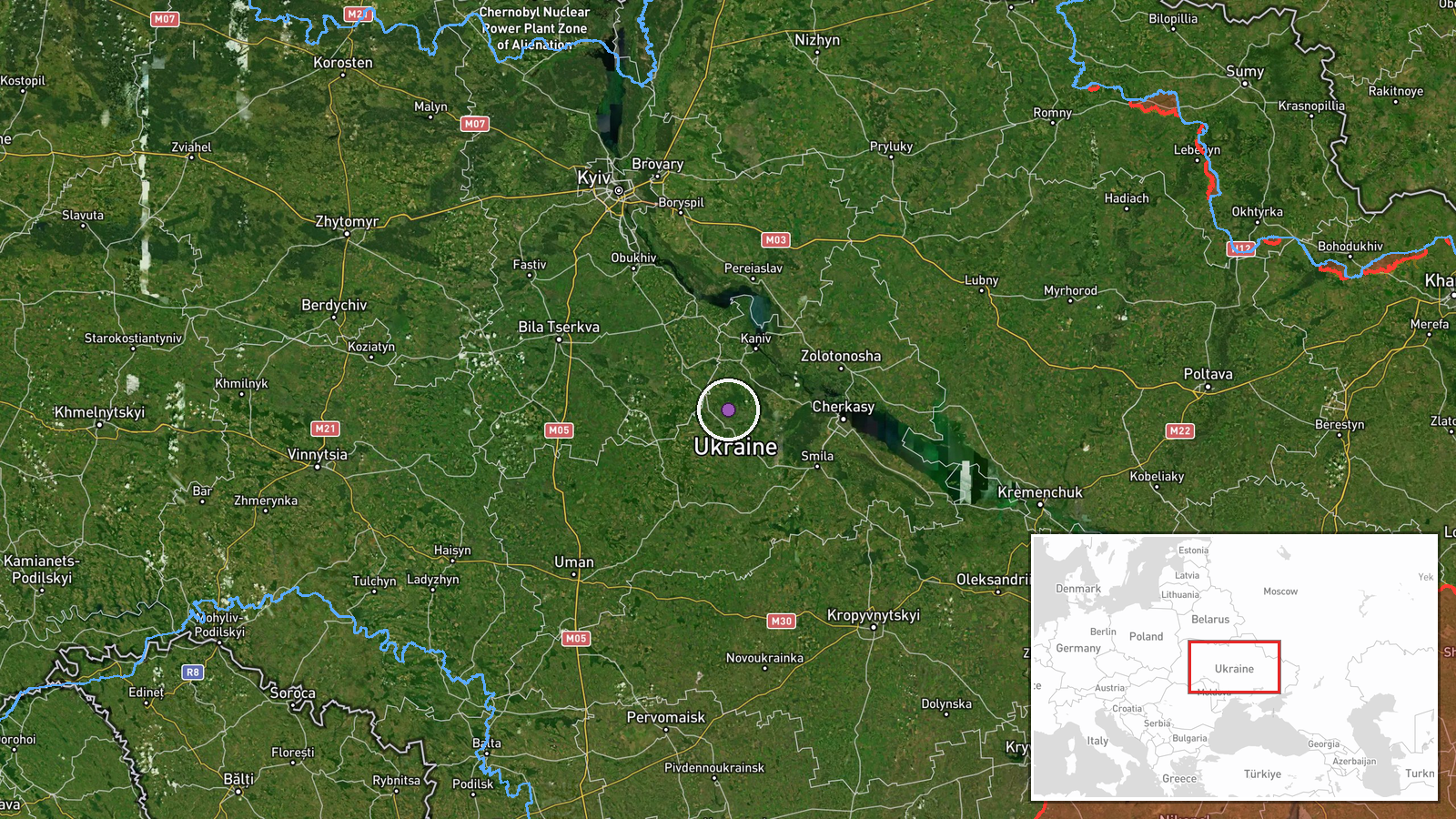
The location is recorded as Ukraine at region precision, with coordinates near 49.49 north, 31.27 east, placing the marker in central Ukraine. The point is a mapping centroid, not a site where throttling was observed or a Starlink facility. The surrounding terrain is largely flat agricultural plain, with the Dnipro River to the east. Because the claim concerns a national network, the marker should be read as approximate.
Related events nearby
- Overnight Russian attack of 165 Shahed-type, Gerbera and decoy drones; 115 shot down or suppressed, 20 still a2026-10-20 05:10 UTC · Air Defense · Ukraine
- Ukrainian General Staff reports 24h Russian attacks: 1 missile strike, 63 airstrikes, 217 guided glide bombs, 2026-10-20 04:07 UTC · Report · Ukraine
- Ukrainian air monitoring: 1 Russian jet-powered Shahed (Geran-3) drone passing Cherkasy Oblast, heading west.2026-10-20 01:49 UTC · Drone Transit · Cherkasy Oblast, Ukraine
- Ukrainian air monitoring: 2+ Russian jet-powered Shahed (Geran-3) drones from Cherkasy Oblast toward Pereiasla2026-10-20 17:04 UTC · Drone Transit · Pereiaslav, Ukraine
- Ukrainian air monitoring: 2+ Russian jet-powered Shahed (Geran-3) drones heading toward Pereiaslav.2026-10-20 15:45 UTC · Drone Transit · Pereiaslav, Ukraine
▶ View this event on the live map

Intel Mapper aggregates open-source reports from monitored Telegram and X channels, geolocates them, cross-checks duplicates across sources and assigns a confidence score. Entries are updated as new confirmations arrive. Read how we verify events.