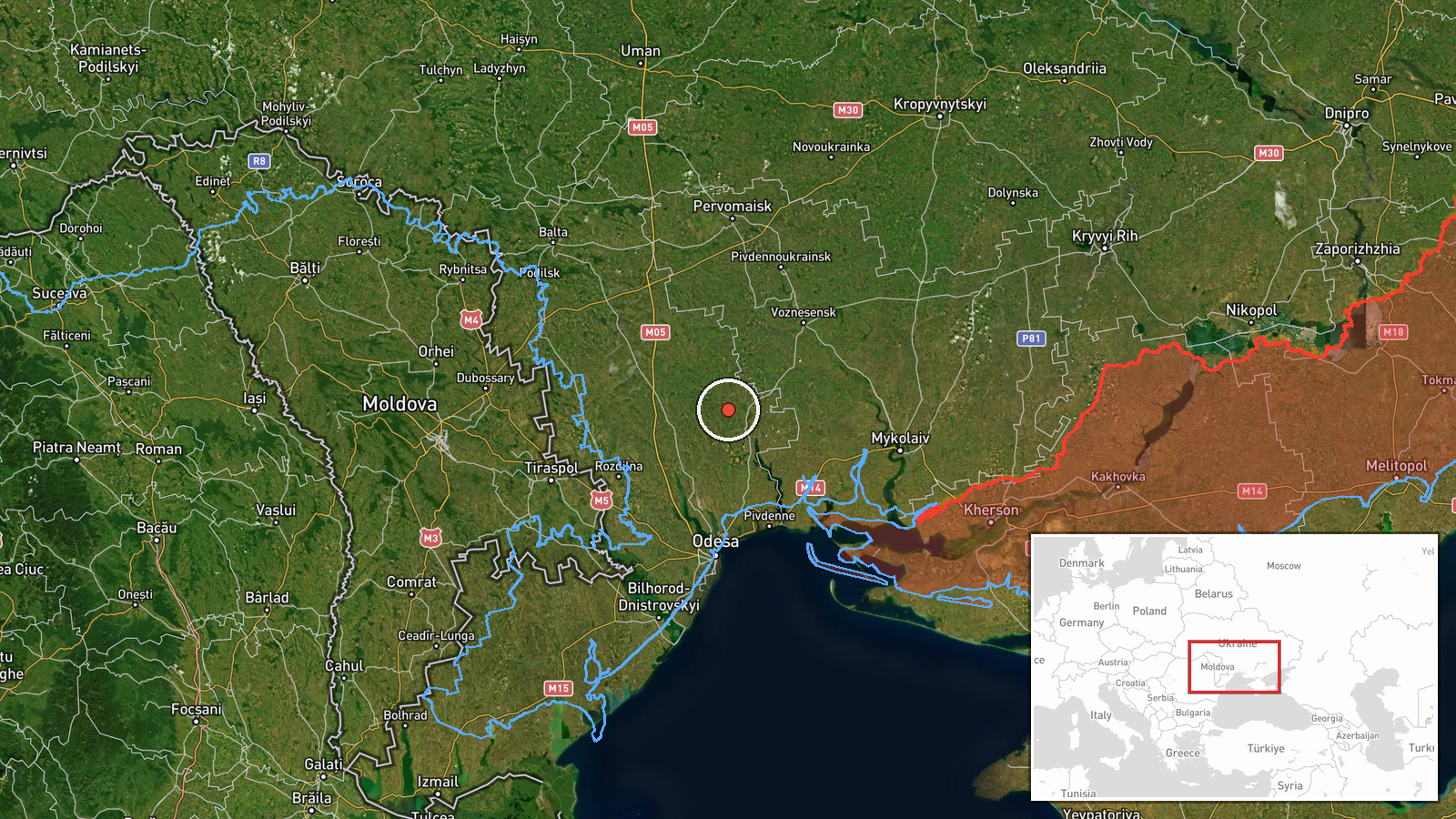
Two or more Russian jet-powered Shahed drones reported transiting near Raukhivka, Odesa Oblast, heading northwest
What happened
Ukrainian air monitoring channel @kpszsu reported on Telegram that two or more Russian jet-powered Shahed (Geran-3) drones were passing Raukhivka in Odesa Oblast, southwestern Ukraine, heading in a northwesterly direction. The report, logged for 20 October 2026 at 02:10 UTC, also mentioned drones passing Zakharivka. The original Ukrainian-language wording describes them as 'jet-powered UAVs' (реактивні БпЛА) and gives a direction of travel but no impact, damage, or casualty information. The post is a single-channel transit observation, and the number of drones is given only as 'two or more' in the source's framing.
Context and assessment
Raukhivka lies in the Odesa region, an area that has seen repeated Shahed-type transits as Russian long-range drone campaigns have pushed along the Black Sea coast toward Odesa, Ochakiv, and the Odesa-Mykolaiv border. The related events in the preceding roughly 24 hours show a consistent pattern: single and multiple Geran-3 drones were reported north of Buialyk, on the Odesa-Mykolaiv boundary, approaching Odesa from the Black Sea, and heading toward Ochakiv on two separate occasions. This repetition suggests the drones are following corridors that run along the coast and then turn inland or northward, rather than striking a single fixed target. The northwesterly heading reported here is consistent with that corridor. Transit reports of this kind are generally used by air defence and civil authorities to track flight paths and issue warnings, and they do not on their own indicate what the drones are aimed at. Jet-powered variants are typically associated with higher speeds than the older piston-engine Shahed design, which can shorten warning times for communities along their path. Operators may be using the approach to test air defence response, to saturate sensors, or to deliver munitions farther north, but the data does not confirm any of these purposes.
Sources and confidence
The report comes from a single channel, the Telegram account @kpszsu, which is associated with the Ukrainian Air Force's official monitoring output. It has not yet been independently replicated by another source in the dataset, so the cross-confirmation status is single-source. The confidence score of 8.0 reflects the official-looking origin and the consistent pattern with several related transit reports, but it is not higher because no second channel, impact report, or independent sensor confirmation is included. Confidence would rise with corroboration from additional air-monitoring channels, regional military administration statements, or reports of impacts or interceptions along the stated path. It would fall if the flight path were revised, if the drone type were disputed, or if the event were later attributed to a different airspace activity.
Location
The location is recorded as Raukhivka, a settlement in Odesa Oblast, with settlement-level precision and high location confidence. The coordinates (approximately 47.17 N, 30.82 E) place the point in the Odesa region, in the steppe and lowland zone north-west of the city of Odesa and close to the Dniester estuary and the Black Sea coastal belt. The nearby Zakharivka is also mentioned in the original report. The area is largely flat agricultural land with river valleys and reservoirs, which makes low-altitude drone tracking more reliant on ground radar and air monitoring posts.
Related events nearby
- Ukrainian air monitoring: 1 Russian jet-powered Shahed (Geran-3) drone passing north of Buialyk, heading north2026-10-19 05:25 UTC · Drone Transit · north of Buialyk, Ukraine
- Ukrainian air monitoring reports jet-powered Shahed (Geran-3) drones on the Odesa-Mykolaiv border, heading nor2026-10-19 14:02 UTC · Drone Transit · Odesa-Mykolaiv Oblast border, Ukraine
- Ukrainian air monitoring: 1 Russian Shahed-type drone from Black Sea toward Odesa.2026-10-19 18:23 UTC · Drone Transit · Odesa, Ukraine
- Ukrainian air monitoring: 1 Russian jet-powered Shahed (Geran-3) drone from Black Sea toward Ochakiv.2026-10-19 20:58 UTC · Drone Transit · Ochakiv, Ukraine
- Ukrainian air monitoring: 1 Russian jet-powered Shahed (Geran-3) drone from Black Sea toward Ochakiv.2026-10-19 06:28 UTC · Drone Transit · Ochakiv, Ukraine
▶ View this event on the live map

Intel Mapper aggregates open-source reports from monitored Telegram and X channels, geolocates them, cross-checks duplicates across sources and assigns a confidence score. Entries are updated as new confirmations arrive. Read how we verify events.