Hormuz stays shut as Witkoff meets Putin
- Witkoff meets Putin in St. Petersburg on Ukraine and Iran.
- Russia frees US citizen Stephen Hubbard after four years jailed.
- Kremlin says it will review every Witkoff proposal; energy truce stance unchanged.
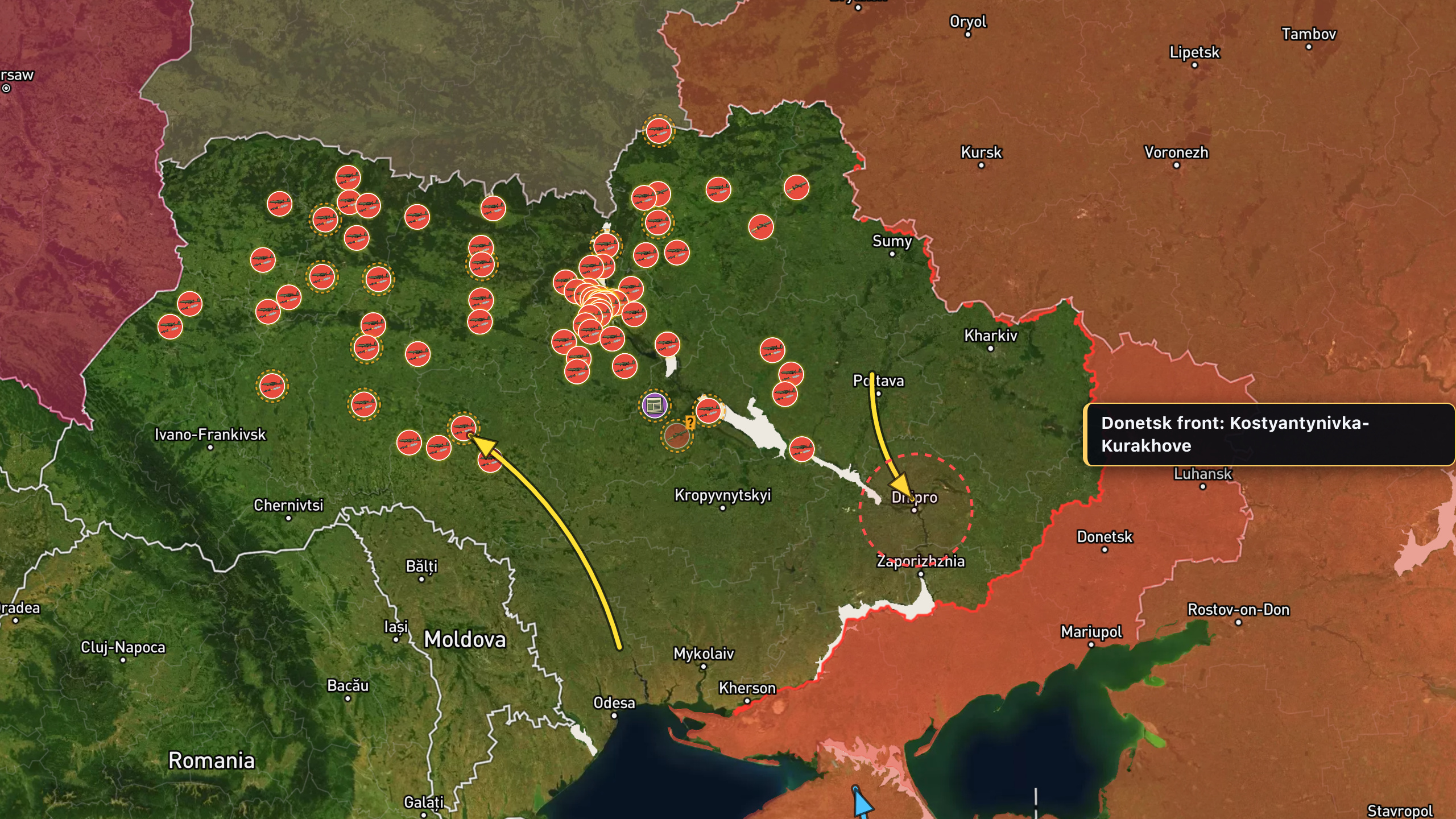
- Geran-3 drones tracked toward Kyiv, Vinnytsia, Zhytomyr and Chernihiv oblasts.
- Ukraine reportedly strikes supply depot near Yani-Kapu, Crimea.
What to watch: In Ukraine, observers should track whether the proposed ceasefire framework advances after the Witkoff visit, and whether the Kremlin's stated openness to a Putin-Trump-Xi meeting produces a concrete date.
Full analysis (637 words)
Diplomacy dominated the Ukraine theatre. Russia released US citizen Stephen Hubbard, 74, after a visit by Trump envoy Steve Witkoff; Hubbard had been jailed for more than four years on disputed charges of fighting for Ukraine. Witkoff was received by Vladimir Putin at the Constantine Palace in St. Petersburg, where talks covered Ukraine and the Iran crisis. Putin said he would raise a possible Putin-Trump-Xi meeting in China and that Russia has further ideas to share. He also claimed that oil and world market prices fell 5 to 6 percent after both sides announced an agreement linked to the Iran crisis. The Kremlin said Putin would review every Witkoff proposal, while spokesman Dmitry Peskov said the energy-ceasefire position is unchanged, that Russia wants peace rather than a truce, and that the conflict cannot be resolved without Kyiv. Zelensky said Russia is not winning on the battlefield and welcomed the US-proposed ceasefire as a diplomatic path, while rejecting pressure to cede land.
Ukrainian air monitoring recorded a steady flow of Russian aerial attacks overnight. Several jet-powered Geran-3 Shahed drones were tracked toward Vinnytsia, Kyiv, Khmelnytskyi, Zhytomyr and Chernihiv oblasts, as well as Solone and Raukhivka. Banderol mini cruise missiles were tracked from Kharkiv and northern Dnipropetrovsk toward Poltava and Dnipro, with shelter warnings issued for Poltava. A Banderol was also tracked passing Kharkiv heading south, and a Shahed-type drone passed eastern Kharkiv and eastern Dnipropetrovsk oblasts. On the Ukrainian side, the General Staff reported strikes overnight on October 20 to 21 on a Russian material-technical supply depot near Yani-Kapu in occupied Crimea, reportedly disrupting unit supply, and on a Russian unit command post near Kurakhove in Donetsk Oblast, reportedly disrupting troop control. Individual unit-level claims remain difficult to verify independently.
The day's pattern shows Moscow pursuing a parallel track of negotiations and sustained long-range strikes, while Kyiv continues deep strikes in occupied areas. A US intelligence assessment, reported by two sources, says Putin ordered escalated sabotage across NATO after a failed explosive-drone attack on Leipzig-Halle airport in August, now reportedly expanding to military suppliers and communications. The Bundeswehr reportedly raised its threat level to second-highest, assessing an imminent sabotage attack on German bases or Ukrainian-linked production facilities. Finland plans to buy one million domestically produced anti-personnel landmines, earmarking about 100 million euros, with domestic production targeted by 2028. AfD leader Alice Weidel called Ukrainian deep strikes on Russian refineries and Moscow-area buildings a dangerous provocation and urged pressure on Zelensky to end the war. These developments suggest European governments are treating hybrid threats and defensive procurement as near-term priorities, even as US-led talks continue.
Assessment
The day combined intensified diplomacy on Ukraine and Iran with continued military pressure on both fronts. Hormuz remains closed under Iranian conditions, and Russia's long-range strikes continued alongside Witkoff-led talks, so neither theatre shows a near-term settlement. Several key claims, including the blocked Israeli strike and the Leipzig sabotage assessment, rest on single or limited reporting and should be treated provisionally. The overall trajectory is one of hardened positions and deterrence signaling rather than a decisive shift.
What to watch
Over the next 24 to 48 hours, attention should focus on whether Iran's Hormuz position changes after Araghchi's plan was delivered to Washington, and whether any US response is publicly reported. Reports of a planned Israeli strike on Iranian nuclear and infrastructure sites, reportedly blocked by Trump, merit monitoring for signs of revived planning, though the source is a single investigative report. In Ukraine, observers should track whether the proposed ceasefire framework advances after the Witkoff visit, and whether the Kremlin's stated openness to a Putin-Trump-Xi meeting produces a concrete date. Continued Russian Shahed and Banderol launches in the Dnipro and Poltava corridors would indicate sustained strike tempo. Finally, German threat-level changes and any confirmed sabotage incidents near NATO defense sites would bear on European security posture.
Sources (14)
This brief is compiled from the day's verified events; each entry links to the event page with media, confidence score and original reporting.
- Russia released US citizen Stephen Hubbard, 74, after a visit by Trump envoy Steve Witkoff. Hubbard had been j (Diplomacy, Moscow, Russia)
- Putin tells envoy Witkoff that Russia values its trust-based relationship with Iran and that Trump attaches im (Statement, Moscow, Russia)
- Putin received US envoy Steve Witkoff at the Constantine Palace in St. Petersburg; talks are underway on Ukrai (Statement, Moscow, Russia)
- Zelensky says Russia is not winning on the battlefield, rejects pressure to leave occupied-threatened land, an (Statement, Kyiv, Ukraine)
- Kremlin spokesman Peskov says Moscow's energy-ceasefire stance is unchanged, Russia needs peace not a truce, a (Statement, Moscow, Russia)
- Ukraine's defense minister and armed forces commander met Lockheed Martin delegation on HIMARS, F-16, and PAC- (Diplomacy, Kyiv, Ukraine)
- Russia launched a mass overnight attack with Iskander-K cruise missiles and 186 drones, including jet Shaheds. (Cruise Missile, Ukraine (location not reported))
- Ukrainian General Staff reports 1,820 Russian losses in 24h, including 11 tanks, 16 armored vehicles, 44 artil (Report, Kyiv, Ukraine)
- Ukrainian General Staff publishes cumulative Russian combat losses for 24.02.2022 through 21.10.2026; the exce (Report, Kyiv, Ukraine)
- Finland plans to buy one million anti-personnel landmines from domestic manufacturers, earmarking about €100 m (Statement, Helsinki, Finland)
- US intelligence says Putin ordered escalated Russian sabotage across NATO after a failed explosive-drone attac (Report, Leipzig-Halle Airport, Schkeuditz, Saxon)
- Ukrainian air monitoring: 2+ Russian jet-powered Shahed (Geran-3) drones from Odesa Oblast toward Vinnytsia Ob (Drone Transit, Vinnytsia Oblast, Ukraine)
- Ukrainian air monitoring: 2+ Russian jet-powered Shahed (Geran-3) drones over Solone. (Drone Transit, Solone, Ukraine)
- Ukrainian air monitoring: 2+ Russian jet-powered Shahed (Geran-3) drones heading toward Kyiv Oblast. (Drone Transit, Kyiv Oblast, Ukraine)